
Erasmus Mundus Scholarship 2027: How to Apply, and Every Visa and Document You Will Need
Published Nov 6, 2026 · Updated Nov 18, 2026
The Erasmus Mundus scholarship is one of the most generous ways to do a master's degree in Europe. It's also one of the most unusual. You don't study at one university. You study at two, three or even four, often in different countries. That's a big part of the appeal, and it's also why the paperwork needs extra care.
Erasmus Mundus Joint Masters (EMJM) are funded by the European Union through Erasmus+. Each programme is run by a group of universities, called a consortium, across at least three countries. There is no single Erasmus Mundus application and no single deadline. Each programme has its own call, its own requirements and its own closing date. Your first step is to search the official Erasmus Mundus catalogue and choose programmes that match your background.
This guide covers both stages: getting the scholarship, and then getting the visas and documents you need to actually move to Europe.
What the Scholarship Covers and Who Can Apply
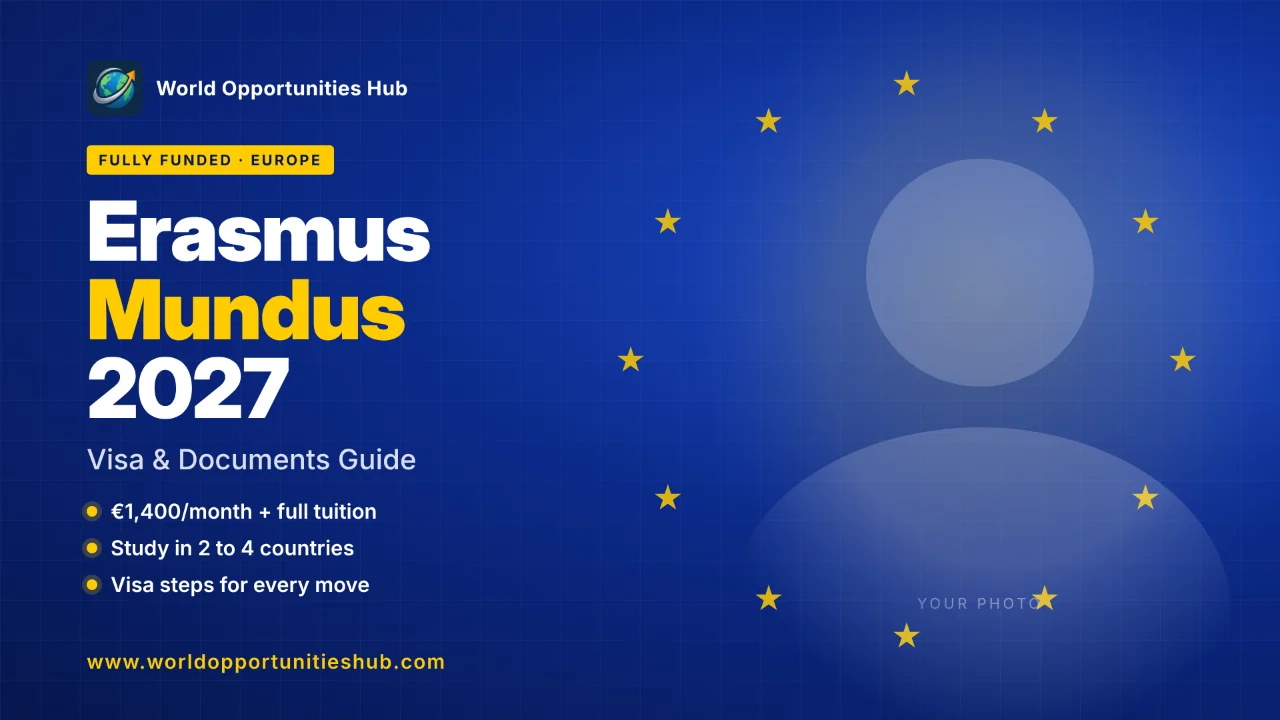
A full Erasmus Mundus scholarship pays €1,400 a month for the whole programme. For a 24-month master's, that comes to €33,600. On top of the monthly allowance, it covers:
- full tuition at every partner university
- a contribution towards travel, visa and settling-in costs
- health insurance for the whole programme
Some consortia let you take part of the money in advance for travel and visa costs, with a slightly lower monthly allowance afterwards.
The programme is open to students from every country, including Pakistan. The basic eligibility rules are:
- a bachelor's degree, or a recognised equivalent, by the time the programme starts
- the English or other language level your programme requires
- no previous Erasmus Mundus Joint Masters scholarship, since you can only receive one
Final-year students can usually apply too, as long as they graduate before the programme begins.
For the 2027 intake, the European Commission selected 37 new programmes in July 2026, in fields like artificial intelligence, semiconductors, medical imaging and sustainability. That's on top of the existing programmes in the catalogue.
Stage One: Documents for the Scholarship Application
You apply directly to each programme through its own online portal, usually on the coordinating university's website. Most programmes ask for some version of the following:
- Online application form, with the box ticked to be considered for the Erasmus Mundus scholarship.
- Bachelor's degree certificate, or a letter confirming your expected graduation date if you're in your final year.
- Academic transcripts for all years, with an explanation of the grading scale.
- English language certificate, such as IELTS, TOEFL or another test the programme accepts.
- CV, often in Europass format.
- Motivation letter. Explain why this programme, why its mix of countries and universities, and what you'll do with the degree.
- Two reference letters, usually from professors, or one academic and one professional.
- Copy of your passport. This is used to confirm your nationality and your scholarship category.
- Proof of residence. Some programmes ask for this to confirm where you've lived for the past five years.
- Portfolio, writing sample or proof of work experience, if your programme asks for it.
The most important thing to watch is the deadline. Many programmes set an earlier scholarship deadline for applicants from outside Europe. Pakistani applicants are in this group, also called "Partner Country" applicants. For example, some 2027 programmes close on 3 January 2027 for Pakistani applicants but stay open until February for applicants from inside Europe. If you apply after your scholarship deadline, you may only be considered for admission, without funding.
You can apply to up to three Erasmus Mundus programmes in the same year. Spreading your applications improves your chances.
Stage Two: Visas for a Multi-Country Degree
This is where Erasmus Mundus differs from almost every other scholarship. You're moving between countries, so you need to think about your visa route for the whole programme, not just the first semester.
Start with the country of your first semester. Any stay longer than 90 days needs a long-stay student visa (a national visa, often called a D visa) or a residence permit from the country where you'll study. A short-stay Schengen visa is never the right document for a semester abroad, so don't travel on a tourist visa.
Plan for each move. When you move to the next country, check what that country requires. A long-stay visa or residence permit from one Schengen country lets you travel within the Schengen area for up to 90 days in any 180-day period. A semester in another country is longer than that. Many EU countries have simplified rules for students in joint programmes like Erasmus Mundus, where a notification may be enough instead of a new visa. But the rules differ from country to country. Your consortium coordinators deal with this every year, so ask them early.
For your first visa application, expect to provide:
- Valid passport that stays valid well beyond your planned stay, with blank pages
- Completed national visa application form for that country
- Biometric photos that meet that country's requirements
- Admission or invitation letter from the consortium
- Erasmus Mundus scholarship award letter, which shows your monthly allowance and how long it lasts
- Proof of health insurance, usually the Erasmus Mundus group insurance certificate
- Proof of accommodation, if the country asks for it
- Attested academic documents, as the embassy requires
- Visa fee, which you can usually cover from the scholarship's travel and visa contribution
Financial Proof
For most countries, your Erasmus Mundus award letter is your main proof that you can support yourself. At €1,400 a month, the scholarship meets or beats the living-cost requirement in most European countries. Keep the original award letter safe, along with your scholarship agreement. You'll need them again at every embassy and immigration office.
If you're on a waiting list and get promoted to a scholarship later, ask the consortium for an updated letter. An embassy will only accept proof that matches your current status.
Health Insurance
Erasmus Mundus scholars are covered by a group insurance plan for the whole programme. The consortium will give you the insurance details and a certificate before you travel. Use this certificate in your visa applications. Check that the cover starts on or before your arrival date, and keep a copy on your phone and in print.
If You Are Applying from Pakistan
1. Watch the Partner Country deadline. Pakistani applicants usually face an earlier scholarship deadline than Europeans. Mark it on your calendar, and submit a day early. A midnight deadline in Central European Time falls in the early hours of the next day in Pakistan.
2. Get your documents attested. University degrees and transcripts go to the HEC first. Matric and Intermediate certificates go to IBCC or your board. After that comes MOFA attestation. Some European countries also ask for embassy attestation or an apostille, so check what the country of your first semester requires.
3. Keep NADRA documents ready. Many European embassies ask for your Family Registration Certificate (FRC) and birth certificate.
4. Know where to apply. Most European countries handle Pakistani visa applications through their embassy in Islamabad, often with VFS Global collecting the documents. Some countries cover Pakistan from an embassy in a nearby country. Check the official website of the country of your first semester.
5. Book your appointment early. Visa appointments can be hard to get in the summer, which is peak season for students. Start as soon as you receive your award letter.
A Realistic Timeline
- September to November: shortlist programmes from the catalogue and start getting your documents attested.
- October to January: applications open and close. Submit before your Partner Country scholarship deadline.
- March to April: results arrive. Accept your place and sign the scholarship agreement.
- April to June: apply for the visa for your first-semester country. Collect your insurance certificate and award letter.
- August to September: travel, register locally and apply for your residence permit if the country requires one.
- Before each move: check the visa or notification rules for your next country with your coordinator.
Mistakes That Cost People Their Visa
- Applying after the scholarship deadline and being considered for admission only
- Travelling on a short-stay Schengen visa for a full semester
- Forgetting to plan for the second or third country of the programme
- Missing HEC or MOFA attestation on a key document
- Using an old award letter after moving from the reserve list to the main list
Final Word
Erasmus Mundus is more than a scholarship. It's two years of living in different countries, learning from different academic traditions, and building a network across Europe. The paperwork is more complex than for a single-country degree, but it's manageable if you plan for the whole journey from the start. Choose your programmes carefully, meet the scholarship deadline, and keep your documents in order. The rest is the adventure.
Published by Jabeen
Editor, WorldOpportunitiesHub
Jabeen researches, writes and fact-checks every opportunity and guide on WorldOpportunitiesHub, verifying each one against its official source before it's published.
Ready to find your next opportunity?
Browse OpportunitiesOpportunities you might like
University of Sydney RTP Scholarship 2027 in Australia (Fully Funded PhD/Research)
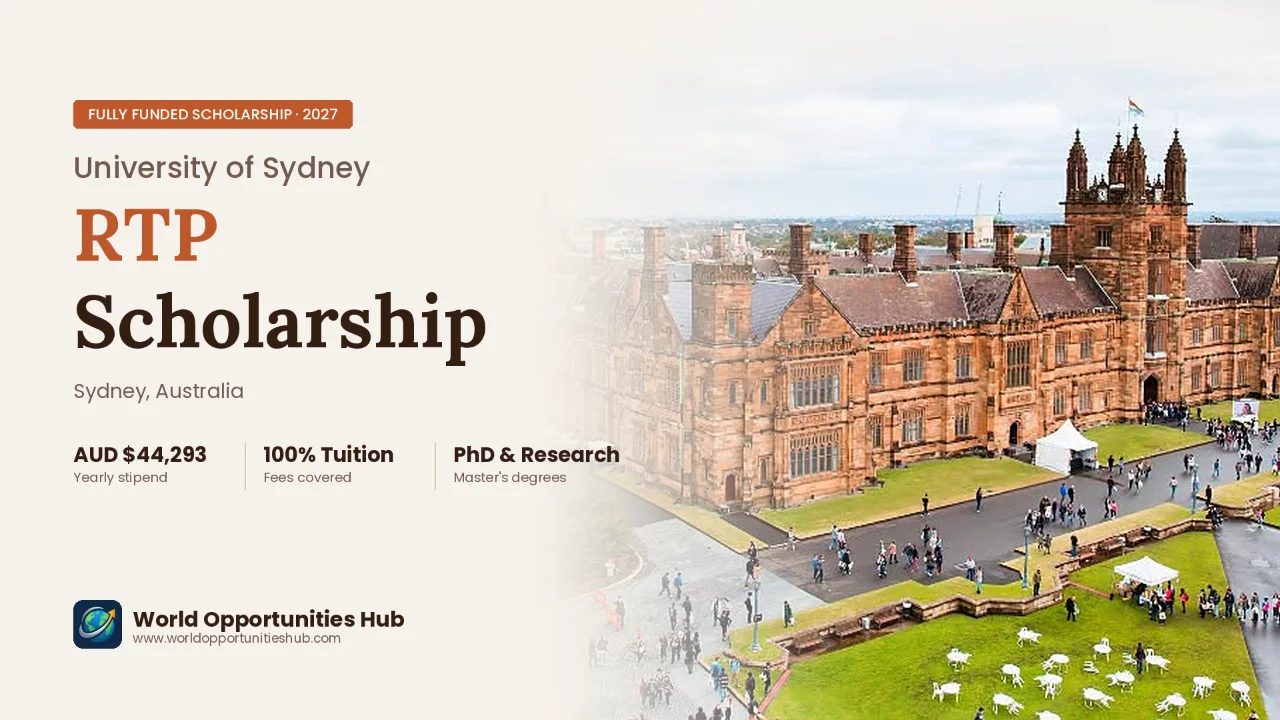
The University of Sydney is offering fully funded Research Training Program (RTP) and equivalent university scholarships to international students starting or already enrolled in a PhD or research master's. It covers a yearly stipend of AUD $44,293 (2027 rate), full tuition fees for up to 14 research periods, and health cover. The next application deadline is December 18, 2026.

Riot Games Social Media Manager Internship 2027 in Los Angeles, USA (Paid)
Riot Games is hiring a Social Media Manager Intern for Summer 2027 in Los Angeles. You'd help run the day-to-day of Riot's global social channels — coordinating content, campaigns and community response across League of Legends, VALORANT and Riot's other games. It's a paid, 12-week internship open to students graduating in 2027 or 2028. Applications close January 4, 2027.
Riot Games Data Engineering Internship 2027 in Los Angeles, USA (Paid)
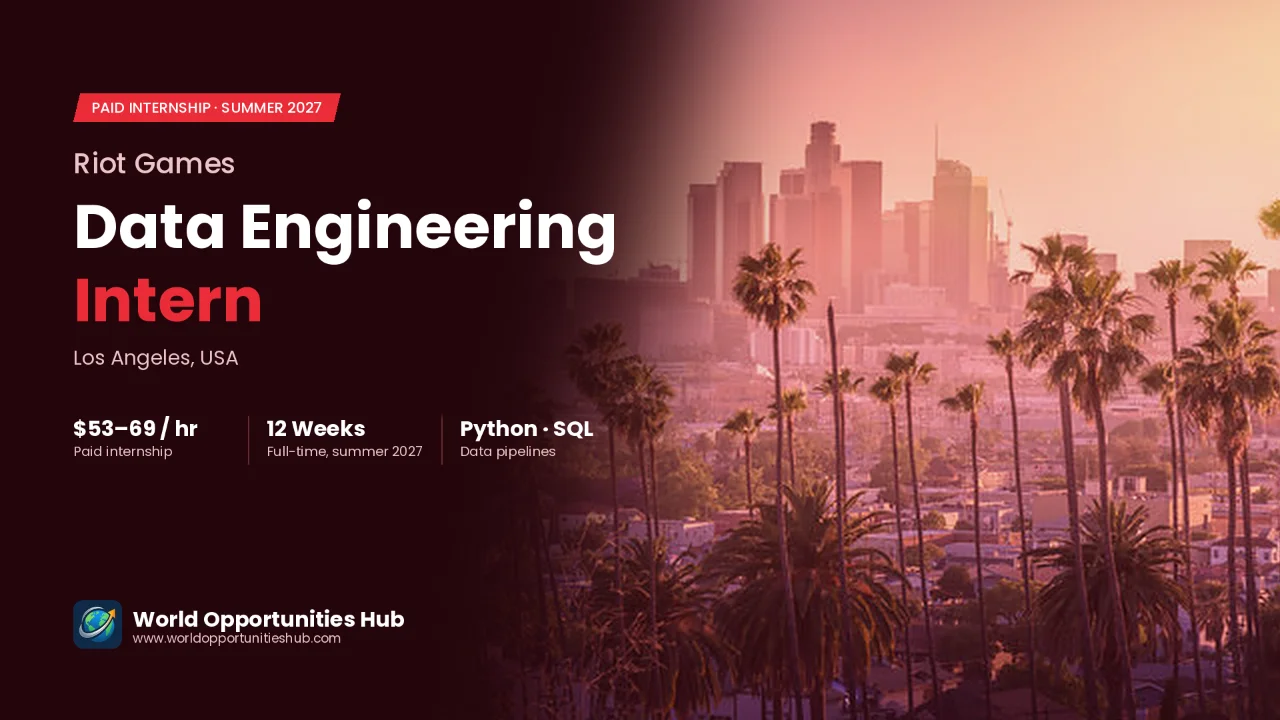
Riot Games is hiring a Data Engineering Intern for Summer 2027 at its Los Angeles studio. You'd work on real data pipelines and datasets alongside Riot's data engineers, data scientists and analysts, using Python or Java and SQL. It's a paid, 12-week internship aimed at students graduating in 2028. Applications close January 4, 2027.