UNESCO-Oxford Free Online Course on Freedom of Expression 2026 (With Certificate)
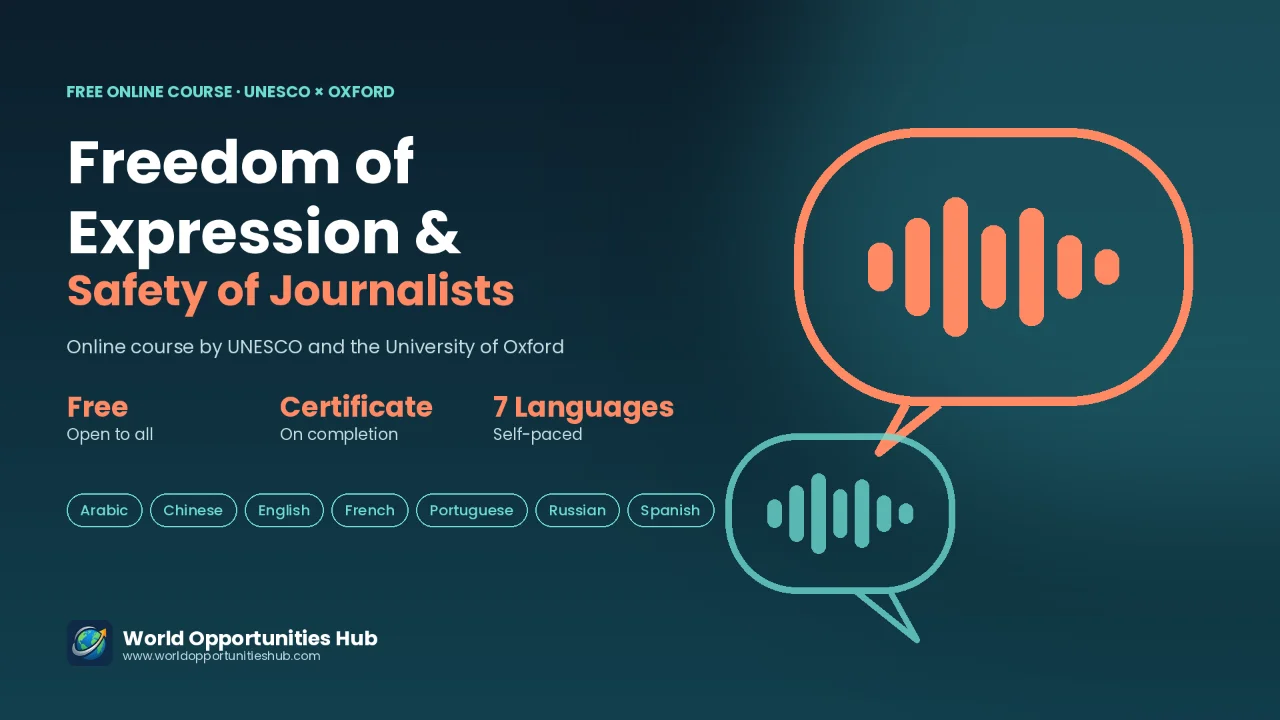
UNESCO and the University of Oxford's Bonavero Institute of Human Rights are offering a free online course on international standards for freedom of expression and the safety of journalists. It's available in seven languages, takes five weekly modules at your own pace, and gives a certificate of completion. It's designed for judges and legal professionals, and open to journalists, students, academics and anyone interested.
Published Nov 5, 2026 · Updated Nov 5, 2026
Last updated: Nov 5, 2026Source: UNESCO and the Bonavero Institute of Human Rights, Faculty of Law, University of Oxford ↗
Overview
Freedom of expression is a basic right, but it's under pressure around the world. Journalists face threats, governments restrict access to information, and the internet has created new challenges such as online harassment and disinformation. Judges, lawyers and journalists are often on the front line of these issues, yet many have never had formal training in international standards on free speech.
To help close that gap, UNESCO and the Bonavero Institute of Human Rights at the University of Oxford run a free online course called International Standards on Freedom of Expression and Safety of Journalists. It's taught by leading academics, available in seven languages, and open to anyone in the world.
Who Is This Course For?
The course is designed mainly for judicial actors from all justice systems, including:
- Judges and members of the judiciary
- Public prosecutors and public defenders
- Electoral court staff
- Human rights ombudsman offices
- Judicial law clerks
It's also open to journalists, academics, students and other professionals worldwide. If you study law, journalism, media or human rights, or work for an NGO on press freedom or digital rights, it's a great way to build your knowledge and add an Oxford-UNESCO certificate to your CV.
Why This Course Stands Out
Courses from Oxford and UNESCO usually come with high fees or strict entry requirements. This one is completely free and open to everyone. It's available in seven languages, so people can learn in the language they're most comfortable with. It's also self-paced, so you can fit it around work or studies.
What You'll Learn
The course covers regional and international standards on freedom of expression, including:
- Press freedom: the rights of the media and the limits on restricting them
- Access to public information: your right to know what governments do
- Safety of journalists: how international law protects reporters from threats and violence
- Digital challenges: how free speech rules apply online, including new problems created by the internet
How the Course Works
- Five weekly modules on the edX platform
- Each module includes written material, pre-recorded webinars, guest speaker videos and quizzes
- You work at your own pace, so there are no fixed class times
- The course runs from 5 October to 9 November 2026, but you can register and complete all modules until 23 November 2026
Available Languages
You can take the course in any of these languages:
- Arabic
- Chinese
- English
- French
- Portuguese
- Russian
- Spanish
Each language has its own edX registration page, so choose the version that suits you.
Can You Still Join?
Yes. Although the course officially started on 5 October 2026, registration stays open until 23 November 2026, and you can work through all five modules at your own pace before then. If you join now, plan to spend a few hours each week so you finish on time.
Tips to Get the Most From the Course
- Register early so you have enough time to complete all five modules before 23 November.
- Set a weekly schedule. Self-paced courses are easy to fall behind on.
- Take notes on key cases and standards. They're useful for your studies, legal work or reporting.
- Complete every quiz, since you need to finish the course successfully to earn your certificate.
- Add the certificate to your CV and LinkedIn once you finish.
Eligibility
- Open to everyone, from any country
- Especially designed for judges, prosecutors, public defenders, law clerks and other judicial actors
- Journalists, academics, students and other professionals are welcome
- No fees, degree or prior experience required
- Internet access to use the edX platform
Benefits / Funding
- Free, open-access course from UNESCO and the University of Oxford
- A certificate of completion for participants who successfully finish
- Taught by leading academics, with guest speakers
- Available in seven languages
- Self-paced online learning
- Practical knowledge of international free speech and press freedom standards
Required Documents
None. You only need a free edX account to register.
How to Apply
- Visit the official course page on the Oxford Law Faculty website.
- Choose your language and open the matching edX link.
- Create a free edX account (or log in).
- Enrol in the course International Standards on Freedom of Expression and Safety of Journalists.
- Complete all five modules and quizzes by 23 November 2026 to earn your certificate.
Important Dates
- 5 October 2026: Course begins
- 9 November 2026: Official course period ends
- *23 November 2026: Last day to register and complete all modules
FAQs
What is this course about?
It covers international and regional standards on freedom of expression, including press freedom, access to information, the safety of journalists and digital challenges.
Who runs the course?
UNESCO and the Bonavero Institute of Human Rights at the University of Oxford's Faculty of Law.
Is the course free?
Yes. The course is free and open to all.
Do I get a certificate?
Yes. Participants who successfully complete the course receive a certificate of completion.
Who can join?
Anyone. It's designed for judicial actors, but journalists, academics, students and other professionals are welcome.
Which languages are available?
Arabic, Chinese, English, French, Portuguese, Russian and Spanish.
Is it too late to join?
No. Registration is open until 23 November 2026, and you can complete the modules at your own pace before then.
How long does the course take?
It has five weekly modules. You can move faster or slower, as long as you finish by 23 November 2026.
Are there live classes?
No. All webinars and videos are pre-recorded.
Where is the course hosted?
On edX, a free online learning platform.
Who do I contact with questions?
Email bonavero.unesco.mooc@law.ox.ac.uk.
WorldOpportunitiesHub is an independent information platform. We are not affiliated with or endorsed by UNESCO and the Bonavero Institute of Human Rights, Faculty of Law, University of Oxford. Always verify details on the official website before applying.
Published by Jabeen
Editor, WorldOpportunitiesHub
Jabeen researches, writes and fact-checks every opportunity and guide on WorldOpportunitiesHub, verifying each one against its official source before it's published.