CEPS Climate Leadership Programme 2026–27 in Brussels, Belgium (Funded)
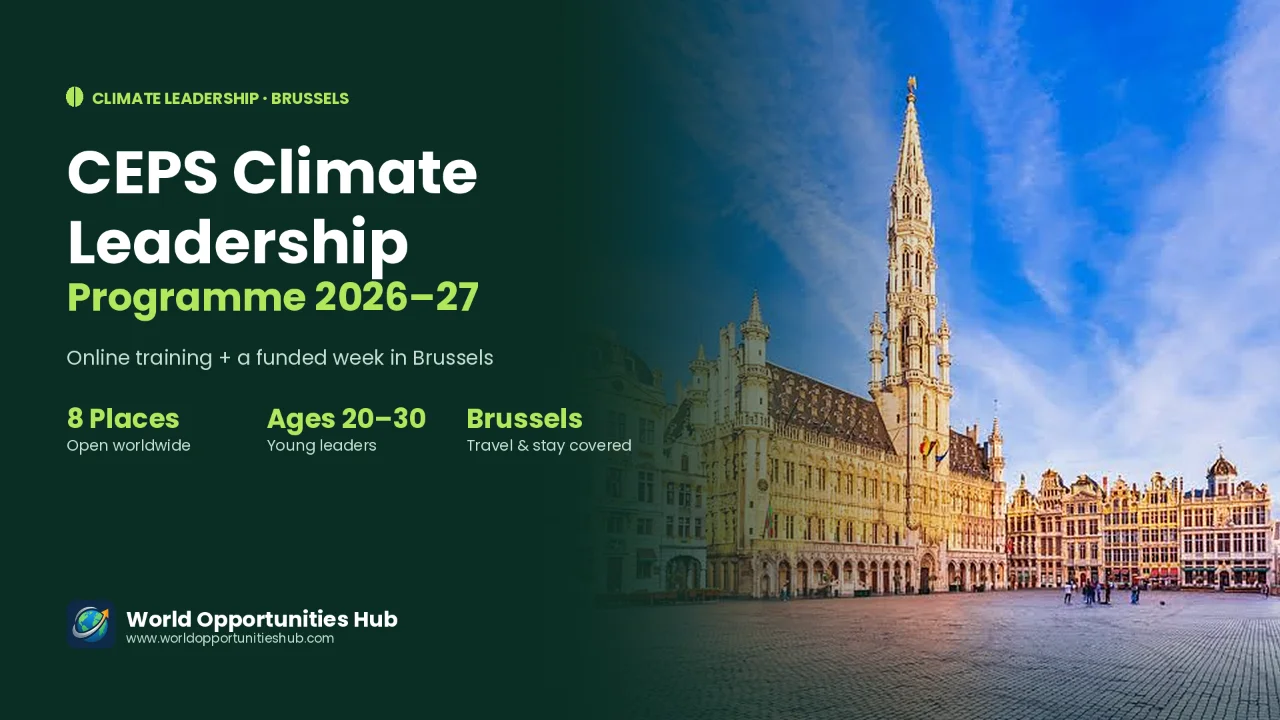
The CEPS Climate Leadership Programme selects eight young climate leaders aged 20–30 from around the world. They take part in online masterclasses on EU climate policy, diplomacy and communication, followed by a funded week in Brussels that includes CEPS's flagship Ideas Lab event. Travel, visa and accommodation costs for Brussels are covered.
Published Nov 6, 2026 · Updated Nov 6, 2026
Last updated: Nov 6, 2026Source: Centre for European Policy Studies (CEPS), with the Heinrich-Böll-Stiftung ↗
The deadline for this opportunity has passed. Check the official website to see if applications reopen, or browse other training programs.
Overview
Climate change is a global problem, but many of the decisions that shape climate action are made in a few places. Brussels is one of them. It's home to the European Union's institutions, think tanks and diplomats, who influence climate policy far beyond Europe. Yet young people from the Global South, who often feel climate change first, rarely get a seat in those rooms.
The CEPS Climate Leadership Programme sets out to change that. Run by the Centre for European Policy Studies (CEPS), one of Europe's leading think tanks, with the Heinrich-Böll-Stiftung, it brings eight young climate leaders from around the world into EU climate policy. They train online for three months, then spend a funded week in Brussels meeting policymakers and joining CEPS's annual Ideas Lab.
Who Is This Programme For?
This programme is for you if you:
- Are between 20 and 30 years old
- Are already active in climate policy, advocacy or entrepreneurship in your own country or region
- Have a specific initiative you want to develop, such as a policy proposal, an advocacy campaign or a green business
- Speak good English
- Can commit to both the online training and the week in Brussels
The programme is open worldwide. CEPS especially welcomes applicants from countries across Africa, Asia, Latin America and Eastern Europe, including Nigeria, Kenya, Uganda, South Africa, India, Brazil, China, Colombia, Morocco, Palestine and Ukraine.
Why This Programme Stands Out
Many climate youth programmes are short events or online-only. This one combines three months of real skills training with a full week in Brussels, where you see EU climate policy being made up close. With only eight places, you get personal attention and the chance to build strong connections with policymakers, researchers and other young leaders. You also bring your own initiative and work on it throughout the programme, so you leave with something concrete.
How the Programme Works
Phase 1 – Online training (December 2026 to February 2027)
You join online masterclasses and skills sessions on:
- EU climate governance: how the EU makes and enforces climate policy
- Climate diplomacy: how countries negotiate on climate
- Policy writing: how to write clear, persuasive policy proposals
- Communication: how to share your message effectively
These sessions are mandatory. Only participants who complete the online phase go on to Brussels.
Phase 2 – Brussels week (28 February to 6 March 2027)
You spend a week in Brussels to:
- See the EU policy landscape first-hand
- Take part in the CEPS Ideas Lab on 4–5 March 2027, CEPS's flagship annual event, which brings together policymakers, experts and business leaders
- Join a side programme organised by the Heinrich-Böll-Stiftung, with details shared with selected participants
What Is the CEPS Ideas Lab?
Ideas Lab is CEPS's biggest event of the year. It brings together EU officials, ministers, researchers, business leaders and civil society to debate Europe's major policy challenges. For a young climate leader, it's a rare chance to hear high-level discussions and meet people who shape European policy.
Visa Requirements
Brussels is in Belgium, which is part of the Schengen Area. If you're from a country that needs a visa to enter Schengen, you'll need a short-stay Schengen visa (type C) for the Brussels week.
- Visa costs are covered by the programme, along with travel and accommodation.
- Apply early. Selected participants are notified by the end of November 2026, giving about three months before the trip. Some countries have long waits for visa appointments, so book one as soon as you're selected.
- Typical documents: a valid passport (usually valid for at least three months after your trip), an invitation letter from CEPS, travel and accommodation details, travel health insurance, and proof of your ties to your home country. The exact list depends on the Belgian embassy or visa centre in your country.
- If you're from a visa-free country, you can usually travel to Belgium for short stays with just your passport, though new EU entry rules may apply.
CEPS usually supports selected participants with invitation letters and visa guidance.
Tips for a Strong Application
- Lead with your initiative. Clearly describe the policy proposal, campaign or venture you want to develop, and why it matters in your context.
- Show your track record. Give concrete examples of your climate work and what it has achieved.
- Connect to EU policy. Explain how learning about EU climate governance will help your initiative or your community.
- Choose a strong referee. Your reference letter should come from someone who knows your climate work well.
- Apply now. The deadline is 10 November 2026, and one listing on the call shows 11 November. Use the earlier date to be safe.
Eligibility
- Aged between 20 and 30
- Already engaged in climate policy, advocacy or entrepreneurship
- Have a specific initiative to develop (such as a policy proposal, advocacy campaign or venture)
- Good command of English
- Available for the full online programme (December 2026 – February 2027) and the Brussels week (28 February – 6 March 2027)
- Open worldwide, with applicants from the Global South especially encouraged
The programme aims for a gender-balanced group with diverse backgrounds and lived experiences.
Benefits / Funding
- Online masterclasses and skills training on EU climate governance, diplomacy, policy writing and communication
- A funded week in Brussels (28 February – 6 March 2027)
- Travel, visa and accommodation costs covered for the Brussels week
- Participation in the CEPS Ideas Lab on 4–5 March 2027
- A Heinrich-Böll-Stiftung side programme in Brussels
- Networking with EU policymakers, experts and other young climate leaders
- Support to develop your own climate initiative
Required Documents
- Completed online application questionnaire (through the form linked on the CEPS page)
- CV in English
- Reference letter in English
How to Apply
- Read the official call on the CEPS website.
- Complete the online application questionnaire through the linked form.
- Email your CV and reference letter (both in English) to the application address on the CEPS call page.
- Use the subject line: "Climate Leadership Programme – [Your Full Name]"
- Submit everything by 10 November 2026, 23:59 CET. Only complete applications will be considered.
Important Dates
- 10 November 2026, 23:59 CET: Application deadline
- End of November 2026: Successful applicants notified
- December 2026 – February 2027: Online masterclasses and training
- 28 February – 6 March 2027: Brussels week
- 4–5 March 2027: CEPS Ideas Lab
FAQs
What is the CEPS Climate Leadership Programme?
It's a programme for eight young climate leaders, combining online training with a funded week in Brussels and CEPS's Ideas Lab.
Who runs it?
The Centre for European Policy Studies (CEPS), a leading European think tank, with the Heinrich-Böll-Stiftung.
What is the age limit?
You must be between 20 and 30 years old.
Can people from Pakistan apply?
Yes. The programme is open worldwide, and CEPS especially welcomes applicants from the Global South.
Is the programme funded?
Yes. Travel, visa and accommodation costs for the Brussels week are covered. The online training is free.
Are meals covered?
The call doesn't say. Ask CEPS directly if you're selected.
Do I need a visa?
If your country needs a Schengen visa for Belgium, yes. Visa costs are covered by the programme.
How many people are selected?
Eight.
Is the online training mandatory?
Yes. Only participants who complete it go on to Brussels.
What documents do I need?
The online application questionnaire, plus a CV and reference letter in English sent by email.
When is the deadline?
10 November 2026 at 23:59 CET.
When will I hear back?
Successful applicants are notified by the end of November 2026.
WorldOpportunitiesHub is an independent information platform. We are not affiliated with or endorsed by Centre for European Policy Studies (CEPS), with the Heinrich-Böll-Stiftung. Always verify details on the official website before applying.
Published by Jabeen
Editor, WorldOpportunitiesHub
Jabeen researches, writes and fact-checks every opportunity and guide on WorldOpportunitiesHub, verifying each one against its official source before it's published.