
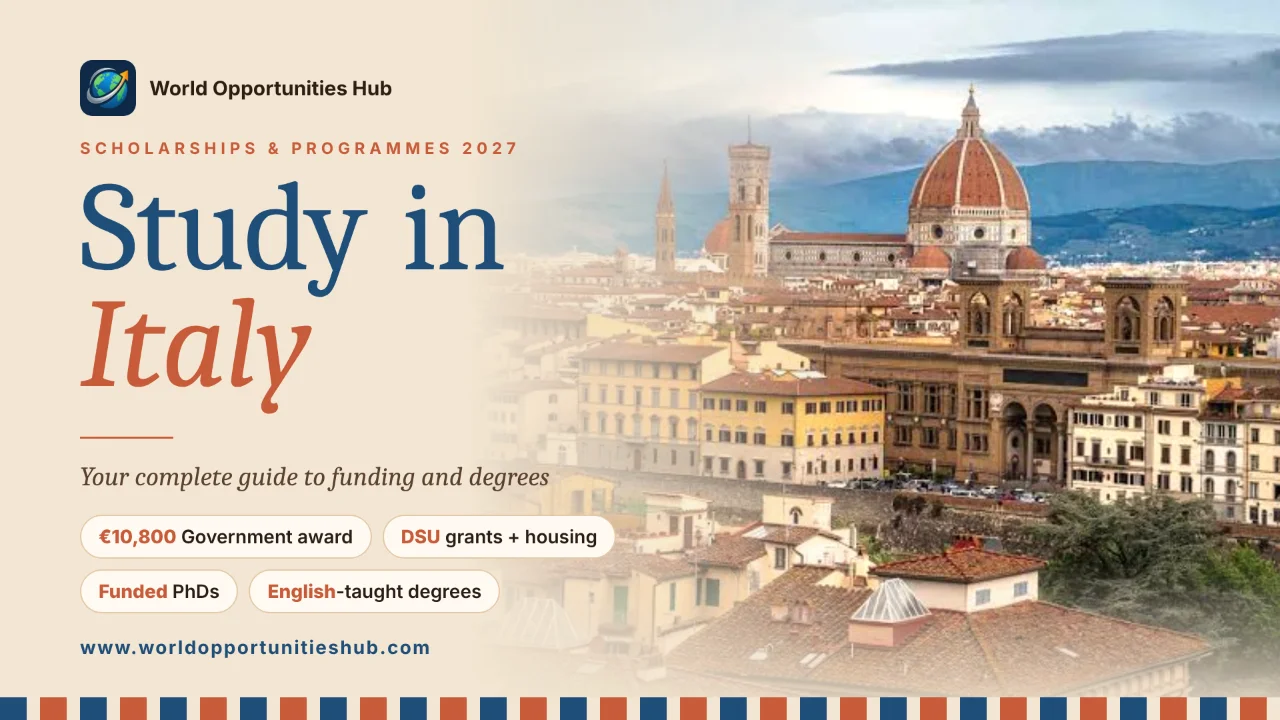
Scholarships and Study Programmes in Italy 2027: The Complete Guide
Italy is one of the most affordable places in Europe to get a world-class degree. Its universities are among the oldest in the world, its public tuition fees are low, and its scholarship system is generous. Many international students study in Italy almost for free.
The key is understanding how Italian funding works. Unlike most countries, Italy has several layers of support: government scholarships, regional grants based on family income, university merit awards and funded PhD positions. You can often combine admission at a top university with one of these, and sometimes more than one.
This guide covers the programmes you can study, every major scholarship, and the visa and documents you'll need.
What You Can Study in Italy
Italian universities offer hundreds of programmes taught fully in English, especially at master's level. You can search them all on Universitaly, the official portal of Italy's Ministry of University and Research. The main options are:
- Bachelor's degree (Laurea): usually three years. English-taught options are growing, especially in business, engineering and economics.
- Master's degree (Laurea Magistrale): two years. This is where most English-taught programmes are, in fields like engineering, data science, economics, international relations, architecture, design and life sciences.
- Single-cycle degrees: five or six years for fields like medicine and dentistry. English-taught medicine requires the IMAT entrance exam.
- PhD (Dottorato di Ricerca): usually three to four years, and most positions come with a scholarship.
- AFAM programmes: degrees in art, music, dance and design at academies and conservatories.
- Foundation year: a preparatory year for students whose school education doesn't fully meet Italian entry requirements.
Popular universities for international students include the University of Bologna, University of Padova, Politecnico di Milano, Politecnico di Torino, Sapienza University of Rome, University of Milan, University of Pavia, University of Pisa and Bocconi University.
1. Italian Government Scholarships (MAECI)
This is Italy's flagship scholarship for international students, offered by the Ministry of Foreign Affairs and International Cooperation through the Study in Italy portal.
- What you get: €10,800 for nine months of study, paid in three instalments. Winners are also exempt from university tuition fees.
- Who it's for: master's students, PhD candidates, researchers and AFAM students. There are also three-month scholarships for advanced Italian language courses.
- When to apply: the call usually opens early in the year. For 2026–27, the deadline was 26 March 2026.
- Renewal: if you're on a multi-year programme, you can apply to renew it the following year.
You apply for the scholarship and for university admission separately. Winning the scholarship doesn't automatically give you a place, so apply to your university as well.
2. Regional DSU Scholarships
This is the scholarship most international students in Italy actually receive, and many have never heard of it. DSU stands for Diritto allo Studio Universitario, meaning "the right to university study". Each Italian region runs its own DSU agency, such as ER.GO in Emilia-Romagna, EDISU in Piemonte, DiSCo in Lazio and DSU Toscana in Tuscany.
- What you get: a yearly cash grant of up to around €6,800 for students living away from home, plus free or subsidised housing, free meals and a tuition fee waiver. The exact package depends on your region and family income.
- How it's decided: DSU is based on financial need, not just merit. If you meet the income limits and academic requirements, you're entitled to it.
- The key document: non-EU students need an ISEE Parificato. This is an Italian certificate that calculates your family's income and assets from documents issued in your home country. A CAF (Italian tax assistance centre) prepares it for you.
- When to apply: most regions publish their calls in July and close applications around early September. Check your region's agency website.
For Pakistani students, the DSU documents usually include a family income certificate, a property certificate and your Family Registration Certificate (FRC). These need to be translated into Italian and legalised at the Italian Embassy, which takes time. Start in May or June.
3. University Scholarships
Many Italian universities run their own scholarships for international students. Some of the best known are:
- University of Padova International Excellence Scholarships: full scholarships for talented students enrolling in English-taught bachelor's and master's programmes.
- University of Bologna Study Grants: grants for international students in bachelor's and master's programmes, including tuition waivers and cash awards.
- Bocconi Merit and International Awards: merit-based awards for bachelor's and master's students at Bocconi, plus need-based support through ISU Bocconi.
- Politecnico di Milano Merit Scholarships: for top international students enrolling in master's programmes in engineering, architecture and design.
- Politecnico di Torino International Scholarships: several types of awards for international students.
- University of Pavia International Scholarships: including awards for students from developing countries.
Deadlines usually fall between February and June, often linked to the university's admission rounds. Some universities consider you automatically when you apply for admission, while others need a separate application.
4. Invest Your Talent in Italy
This programme combines a nine-month scholarship, a tuition waiver and a mandatory internship at an Italian company. It covers English-taught master's programmes in engineering, economics and design. It's only open to citizens of a fixed list of countries, which changes each year. Recent lists have included India, Bangladesh, Indonesia, Egypt and Vietnam, but not Pakistan. Check the official call for the current list before you apply. The 2026–27 deadline was 11 May 2026.
5. Funded PhD Positions
If you're aiming for a doctorate, Italy is one of the best options in Europe. Most PhD positions come with a scholarship (borsa di dottorato) and no tuition fees.
- The national minimum is €16,243 gross a year, and many universities now pay more. Some programmes pay over €18,000, and a few go above €25,000.
- The stipend goes up by 50% while you do research abroad.
- Most PhD students also get a research budget of at least 10% of their stipend.
Universities publish PhD calls once a year, usually between April and June, for programmes starting in October or November.
6. Erasmus Mundus Programmes with Italian Partners
Many Erasmus Mundus Joint Masters include an Italian university. These pay €1,400 a month plus full tuition and travel support, and let you study in two or more European countries. Most applications close between October and January.
Documents for Scholarship and University Applications
Most applications will ask for:
- Passport copy
- Degree certificates and transcripts for every degree
- CV, often in Europass format
- Motivation letter
- Reference letters from professors or employers
- English language proof: IELTS, TOEFL or an MOI certificate where accepted
- Dichiarazione di Valore or CIMEA statement: a document that confirms the value of your foreign degree in Italy. Ask your university which one they accept.
- ISEE Parificato and family documents for DSU applications
Getting Your Italian Student Visa
Once you're admitted, you'll need a long-stay student visa (Type D). Here's how it works.
Step 1: Pre-enrol on Universitaly. This is mandatory for non-EU students. You choose your university and programme, upload your documents, and your university validates your application. You can't apply for a visa until this is done. If your pre-enrolment is still marked "under condition", you can't apply yet either.
Step 2: Gather your visa documents. Most Italian embassies ask for:
- valid passport
- national visa application form
- recent passport photo
- signed Universitaly pre-enrolment summary
- proof of financial means: at least €10,179.85 a year for 2026–27, shown through bank statements, a scholarship letter or a sponsor
- proof of accommodation in Italy
- health insurance valid in Italy
- flight reservation
- legalised or apostilled academic documents with translations
Step 3: Book your appointment. In many countries you book through the Prenot@mi portal or a visa centre such as VFS Global.
Step 4: Get your residence permit. Within eight days of arriving in Italy, you must apply for a residence permit for study (permesso di soggiorno).
One important update: Italy raised the minimum funds for student visas to €10,179.85 a year for 2026–27 and 2027–28. That's a big increase from the earlier figure of about €6,900. If you have a MAECI or DSU scholarship, your award letter can count towards this.
If You Are Applying from Pakistan
- Attest your documents. University degrees and transcripts go to the HEC first, then to MOFA. For school certificates, go to IBCC or your board first.
- Get your degree assessed. You'll need a Dichiarazione di Valore from the Italian Embassy in Islamabad, or a CIMEA statement if your university accepts it.
- Prepare DSU documents early. Your family's income certificate, property certificate and FRC must be translated into Italian and legalised. These steps take weeks.
- Plan for visa appointments. Demand at the Italian Embassy in Islamabad is high in summer, so book as soon as your Universitaly pre-enrolment is validated.
- Show strong finances. Make sure your bank statements meet the new €10,179.85 minimum, or attach your scholarship award letter.
A Realistic Timeline
- October to January: shortlist universities and programmes on Universitaly. Prepare your documents and start HEC and MOFA attestation.
- January to May: apply for admission and university scholarships. Watch for the MAECI call, usually open until around March.
- April to June: apply for PhD positions and Invest Your Talent (if your country is eligible). Start gathering ISEE Parificato documents for DSU.
- May to July: complete Universitaly pre-enrolment and apply for your visa.
- July to September: apply for your regional DSU scholarship.
- September to October: arrive in Italy, apply for your residence permit and start your studies.
Final Word
Italy rewards students who plan ahead. With the right mix of a government scholarship, a regional DSU grant or a university award, you can study at one of Europe's oldest and most respected universities for very little. Some students pay nothing at all. Start early, prepare your documents carefully, and apply to more than one scholarship. Italy's universities, its history and its way of life are waiting for you.
Published by Jabeen
Ready to find your next opportunity?
Browse OpportunitiesOpportunities you might like
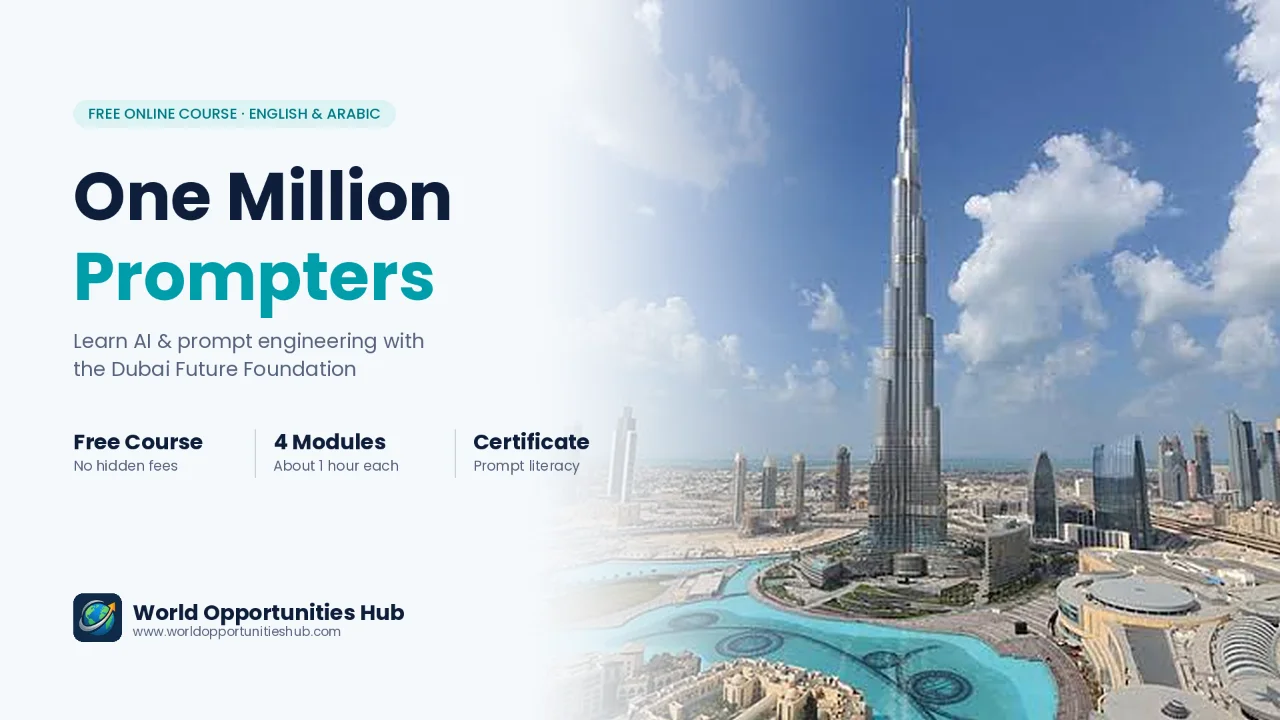
One Million Prompters: Free Online AI and Prompt Engineering Course with Certificate
One Million Prompters is a free online course from the Dubai Future Foundation that teaches anyone how to use AI tools effectively. In four short modules, you learn the basics of AI and generative AI, prompt engineering, AI tools for office work, and creative AI for art, music and video. The course is self-paced, available in English and Arabic, and gives you a Prompt Literacy Certificate when you finish.
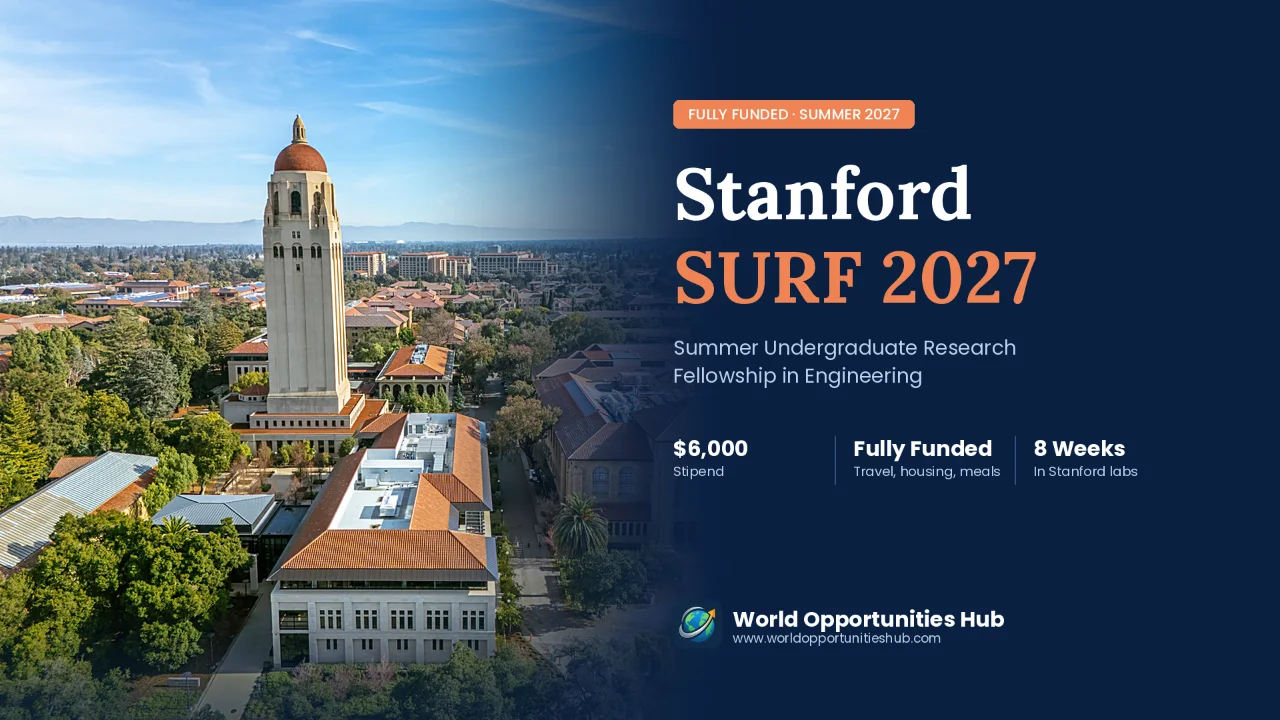
Stanford SURF 2027: Summer Undergraduate Research Fellowship in Engineering (Fully Funded)
Stanford's Summer Undergraduate Research Fellowship (SURF) is a fully funded, eight-week summer research program for undergraduates who want to pursue a PhD in engineering. Fifteen fellows join Stanford Engineering labs, get mentoring and PhD application support, and receive a $6,000 stipend. Travel, housing and meals are all covered. The program especially welcomes first-generation, low-income and under-resourced students.
Anthropic Academy: Free Online AI Courses with Certificates (Self-Paced)
Anthropic Academy is a free online learning platform from Anthropic, the AI company behind Claude. It offers more than 20 self-paced courses for everyone from complete beginners to developers, educators, students, nonprofits and small businesses. You learn how to use AI effectively, ethically and safely. Signing up only takes an email address, and you can earn a certificate when you finish a course.