Stanford SURF 2027: Summer Undergraduate Research Fellowship in Engineering (Fully Funded)
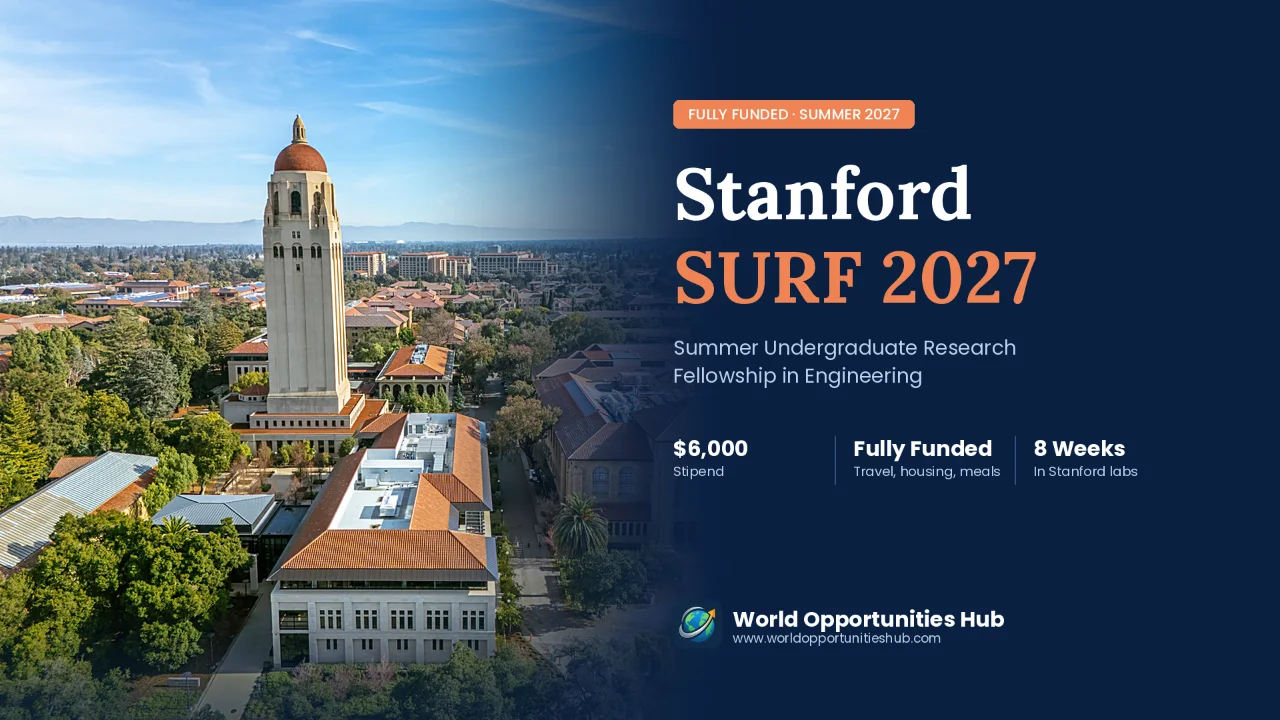
Stanford's Summer Undergraduate Research Fellowship (SURF) is a fully funded, eight-week summer research program for undergraduates who want to pursue a PhD in engineering. Fifteen fellows join Stanford Engineering labs, get mentoring and PhD application support, and receive a $6,000 stipend. Travel, housing and meals are all covered. The program especially welcomes first-generation, low-income and under-resourced students.
Published Nov 8, 2026 · Updated Nov 8, 2026
Last updated: Nov 8, 2026Source: Stanford University School of Engineering ↗
Overview
For many undergraduates, a PhD in engineering feels out of reach. They haven't had the chance to do real research, they don't know how graduate admissions work, and nobody around them has gone down that path. Stanford's Summer Undergraduate Research Fellowship (SURF) is designed to change that.
Run by the Stanford University School of Engineering, SURF brings a small group of 15 undergraduates to Stanford for eight weeks each summer. Fellows join a real research lab, work alongside Stanford faculty and graduate students, and learn what it takes to get into a PhD program. Everything is paid for, and fellows also receive a $6,000 stipend.
The 2027 program runs from 21 June to 13 August 2027 on Stanford's campus in California.
Who Is This For?
SURF is for undergraduates who:
- Are currently enrolled full-time at a US college or university (not at Stanford)
- Are rising juniors or non-graduating seniors who have finished their sophomore year
- Are seriously interested in a PhD in engineering
- Have a GPA of 3.0 or higher (exceptions may be considered)
The program puts a special focus on first-generation college students, students from low-income backgrounds, and students from under-resourced institutions that have limited research opportunities.
Can international students apply? Yes, if you're already studying full-time in the US and your school approves CPT (Curricular Practical Training). Students studying outside the US aren't eligible.
Why It Stands Out
Summer research programs are common, but SURF is special for a few reasons:
- It's Stanford. You do research at one of the world's top engineering schools.
- Everything is covered: travel, housing, meals, Stanford summer registration and health insurance if you need it.
- $6,000 stipend: a real income for your summer.
- Small cohort: only 15 fellows, so you get close mentoring and attention.
- PhD preparation: the program explains how graduate admissions work, which most students never get taught.
- Built for access: it's designed for talented students who haven't had the same opportunities as others.
What Fellows Do
Over eight weeks, SURF fellows take part in:
1. Research in a Stanford lab
Each fellow joins a Stanford Engineering research group and works on a real project with faculty and graduate student mentors. Labs come from a range of engineering fields, and the 2027 host labs and projects are listed in a spreadsheet linked from the official page.
2. Graduate school preparation
Fellows learn how PhD applications work: writing a strong statement of purpose, getting good recommendation letters, choosing programs and preparing for the next step.
3. Mentorship and networking
Fellows connect with Stanford faculty, PhD students and each other, building a network that lasts well beyond the summer.
4. Community events
The program includes social and community-building activities on campus and around the San Francisco Bay Area.
5. Research symposium
At the end of the summer, fellows present their work at a symposium with a poster session and lightning talks, which is great experience for future conferences and PhD applications.
Funding Explained
- Travel: your transport to and from Stanford is covered
- Housing and meals: fully covered throughout the program
- Stipend: $6,000, paid after you successfully complete the program
- Registration: Stanford summer registration costs are covered
- Health insurance: provided if you need it
Since the stipend is paid at the end, plan any personal expenses for the first few weeks accordingly.
Visa Requirements
SURF is open to international students only if they're already studying full-time in the US. Here's what that means in practice:
- You need to be on a valid student visa (usually F-1) at a US college or university.
- CPT approval is required. Curricular Practical Training lets F-1 students take part in work or research experiences related to their studies. Talk to your school's international student office (DSO) early to check whether you're eligible for CPT and how long approval takes.
- No new visa is issued for SURF. Students living or studying outside the US can't apply, so this program isn't open to students applying directly from Pakistan or other countries.
- Check with your school's international office about any other requirements before you apply.
Who Should Not Apply
SURF has a clear focus. It's not a good fit if:
- You're a Stanford student
- You're planning an MD, MD-PhD, JD, MBA, non-engineering PhD or a non-research master's
- You're already a master's or PhD student
- You're graduating before or right after the program (you need at least one more semester or quarter after the summer)
- You'll be taking summer classes, doing an internship or working during the program
Tips for a Strong Application
- Make your PhD goal clear. Explain why you want a PhD in engineering and what kind of research excites you.
- Show your research readiness. Mention any lab work, projects, coursework or independent research, even small ones.
- Look at the host labs. Check the 2027 lab list and mention research areas that match your interests.
- Pick the right recommenders. Ask professors or research supervisors who know your academic work well.
- Write the optional ELC statement. It's strongly encouraged and lets you share your background, values and perspective.
- Write it yourself. Stanford strongly discourages using ChatGPT or other AI tools to write your application.
- Attend an information session to learn more and ask questions.
- Submit early. Emailed or incomplete applications won't be reviewed.
Eligibility
- At least 18 years old
- Currently enrolled full-time at an accredited US college or university (public or private)
- Not a Stanford student
- Rising junior or non-graduating senior who has finished sophomore year (4 semesters or 6 quarters), with at least one semester or quarter left after the program
- GPA of 3.0 or higher (exceptions possible for special circumstances or a clear upward trend)
- Committed interest in a PhD in an engineering field
- Not currently a master's or doctoral student
- Available for the full program (21 June – 13 August 2027)
- No summer classes, internships or jobs during the program
- Full-time community college students in their transfer year can apply if they're transferring to a four-year school in Fall 2027
- International students eligible only if studying full-time in the US with CPT approval
Benefits / Funding
- Eight-week research experience in a Stanford Engineering lab
- $6,000 stipend
- Travel, housing and meals fully covered
- Stanford summer registration costs covered
- Health insurance if needed
- Graduate school and PhD application preparation
- Mentoring from Stanford faculty and graduate students
- Community events around the Bay Area
- Research symposium with poster presentations and lightning talks
- A strong network of future engineering researchers
Required Documents
- Resume/CV: typed, single-spaced, 1–2 pages
- Academic transcript: unofficial is fine
- Statement of purpose: typed, single-spaced, 1–2 pages, covering your academic preparation, research interests, goals and why you want a PhD
- Two letters of recommendation: ideally from professors or research supervisors
- Enhancing the Learning Community (ELC) statement: optional but strongly encouraged, about 500 words
How to Apply
- Read the full details on the official SURF page.
- Check the 2027 host labs and projects list.
- Attend an information session or application office hours (optional but helpful).
- Prepare your resume, transcript, statement of purpose and optional ELC statement.
- Ask two recommenders to submit their letters.
- Submit everything through the SlideRoom portal (stanfordeii.slideroom.com).
- Apply before 1 February 2027, 11:59 pm Pacific Time.
Important Dates
- 1 November 2026: Applications open
- 10 November 2026: Information session (9–10 am PT)
- 17 December 2026: Information session (3–4 pm PT)
- 12 January 2027: Information session (9–10 am PT)
- 27 and 29 January 2027: Application office hours
- 1 February 2027: Application deadline (11:59 pm PT)
- Mid-March 2027: Decisions announced
- 21 June – 13 August 2027: SURF program at Stanford
FAQs
What is Stanford SURF?
It's a fully funded eight-week summer research program at Stanford Engineering for undergraduates who want to pursue a PhD in engineering.
Is it fully funded?
Yes. Travel, housing and meals are covered, and fellows get a $6,000 stipend.
How many students are selected?
About 15 fellows.
Can international students apply?
Only if they're studying full-time at a US college or university and have CPT approval. Students outside the US can't apply.
Can students from Pakistan apply?
Only Pakistani students who are already enrolled full-time at a US university, with CPT approval.
Can Stanford students apply?
No. SURF is only for non-Stanford undergraduates.
What's the minimum GPA?
3.0, though exceptions may be considered.
Can community college students apply?
Yes, if they're in their transfer year and moving to a four-year school in Fall 2027.
Is there an interview?
Interviews aren't a standard part of the process.
Can I use ChatGPT to write my application?
Stanford strongly discourages it.
When will I hear back?
All applicants are notified by mid-March 2027.
Who do I contact with questions?
Email surf-program@stanford.edu.
WorldOpportunitiesHub is an independent information platform. We are not affiliated with or endorsed by Stanford University School of Engineering. Always verify details on the official website before applying.
Published by Jabeen
Editor, WorldOpportunitiesHub
Jabeen researches, writes and fact-checks every opportunity and guide on WorldOpportunitiesHub, verifying each one against its official source before it's published.