Reagan-Fascell Democracy Fellowship 2027–28 in Washington, DC, USA (Fully Funded)
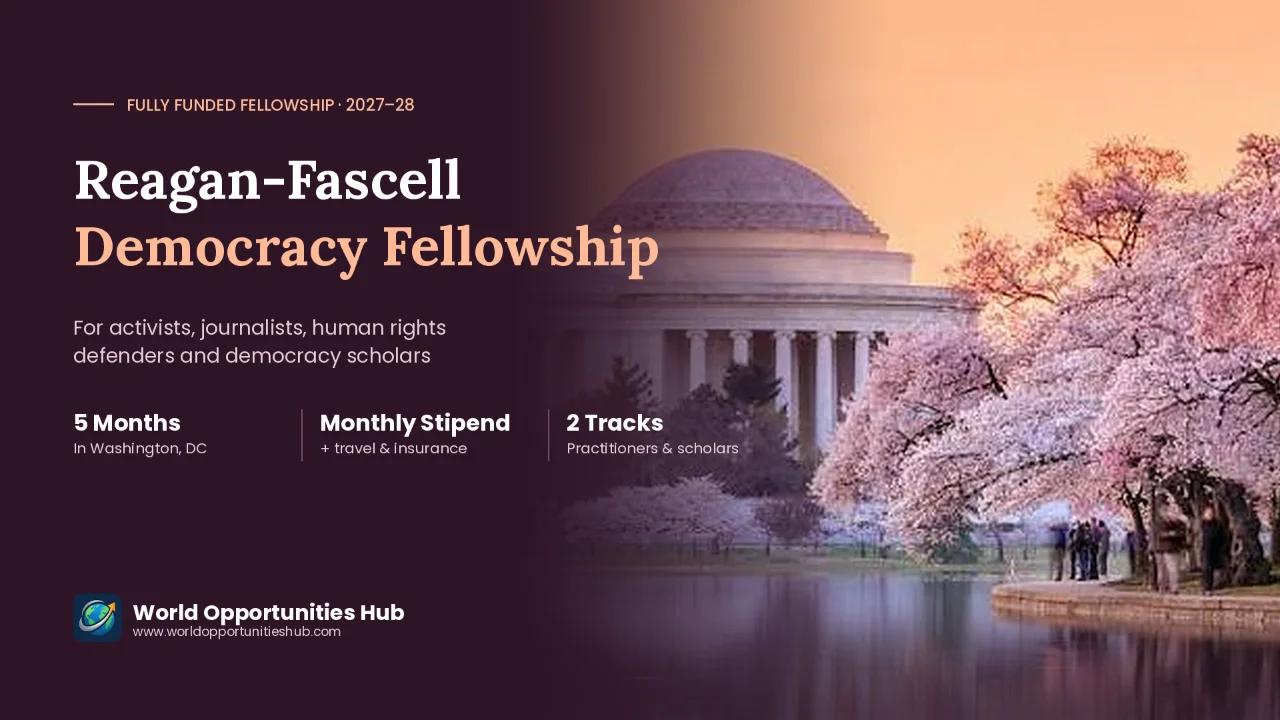
The Reagan-Fascell Democracy Fellowship is a five-month, fully funded residential fellowship at the National Endowment for Democracy in Washington, DC. It's for democracy activists, human rights defenders, journalists, civil society leaders and scholars from around the world. Fellows work on a project about democracy in their country or region, with a monthly stipend, travel, health insurance and research support.
Published Nov 7, 2026 · Updated Nov 7, 2026
Last updated: Nov 7, 2026Source: National Endowment for Democracy (NED), International Forum for Democratic Studies ↗
Overview
Around the world, people working for democracy and human rights often do it under pressure: limited resources, little time to step back and think, and sometimes real danger. The Reagan-Fascell Democracy Fellows Program gives them five months to do exactly that: reflect, research, write, and connect with people who can support their work.
The fellowship is run by the International Forum for Democratic Studies at the National Endowment for Democracy (NED) in Washington, DC. It's named after former US President Ronald Reagan and the late Congressman Dante Fascell. Since it began, it has hosted hundreds of activists, journalists and scholars from around the world, who have used their time in Washington to develop ideas, share their experiences and build global networks.
Who Is This Fellowship For?
There are two tracks:
Practitioner track
For mid-career democracy and human rights professionals, such as:
- Civil society and NGO leaders
- Human rights lawyers
- Journalists and media professionals
- Political party figures and parliamentarians
- Labor activists
No degree is required, and there's no age limit. What matters is your hands-on experience promoting democracy or human rights.
Scholarly track
For researchers who:
- Hold a PhD (or equivalent) when they apply
- Have a publication record in their field
- Have a detailed research outline
Scholars from the US and other established democracies can apply to this track.
Why This Fellowship Stands Out
Most fellowships for activists are short trainings or conferences. This one gives you five full months in Washington, DC, with a stipend, an office and a research team to help you. You're surrounded by other democracy fighters from around the world and have access to Washington's policymakers, think tanks and media. For someone who has spent years on the front line, it's a rare chance to step back, write and plan the next stage of their work.
What Fellows Work On
Each fellow works on a project about democracy in a specific country or region. It doesn't need to study American democracy. Fellows often focus on key challenges such as:
- Authoritarian influence across borders
- Digital technology and democracy
- Transnational repression, when governments target critics abroad
During the fellowship, you develop a plan or response to your chosen issue, often with a comparative focus. By the end, you must produce:
- A final product, such as an article, report, handbook, toolkit, podcast or video (in English or another language)
- A formal presentation of your work
What Life Looks Like as a Fellow
- Five months in residence in Washington, DC
- A fully equipped office at NED
- Research support, including help with research, writing, editing, outreach and preparing presentations
- Seminars, roundtables, field trips and social events with other fellows and the wider democracy community
- A short-term furnished apartment, paid for from your stipend
You can bring family members, but you must pay for their travel and stay yourself.
Visa Requirements
If you're not a US citizen or permanent resident, you'll need a J-1 exchange visitor visa. Family members joining you need J-2 visas.
- NED sponsors the visa. As a federally funded exchange programme, NED provides the documents you need to apply for a J-1 at the US embassy in your country.
- Book your visa appointment early. Wait times at some US embassies can be long.
- Two-year home residency rule: J-1 fellows are usually required to return to their home country for two years after the fellowship before they can apply for certain US visas, such as an H work visa, L visa or permanent residence.
- Recent J-1 researchers can't apply. If you took part in a J-1 research scholar programme in the 24 months before the fellowship, you're not eligible.
How Selection Works
The fellowship runs an annual competition. Applications go through a rigorous review, and finalists are chosen by NED's Board of Directors. Deferrals are generally not allowed, so only apply if you can commit to the full five months in the 2027–28 fellowship year.
Using AI in Your Application
NED has clear rules:
- Not allowed: pasting AI-generated answers into your application
- Allowed: limited use for brainstorming ideas, editorial suggestions or translation, as long as it doesn't significantly change your writing style or content
Tips for a Strong Application
- Focus your project. Pick one clear issue in one country or region and explain why it matters now.
- Show your track record. For the practitioner track, give concrete examples of your work for democracy or human rights.
- Describe your final product. Explain what you'll create (a report, toolkit, podcast or similar) and who will use it.
- Choose strong referees. Ask people who know your work well, and remind them their letters are due by 12 January 2027.
- Write in your own voice. NED wants your real ideas, not AI-written text.
Eligibility
For all applicants:
- Proficient in English
- A project on the political, social, economic, legal or cultural aspects of democratic development
- Able to live in Washington, DC for the full five months, with no other fellowship or job during that time
- Not a former Reagan-Fascell fellow
- Not a J-1 research scholar in the 24 months before the fellowship
Practitioner track:
- Substantial practical experience promoting democracy or human rights
- No degree or age requirement
Scholarly track:
- A PhD (or equivalent) at the time of applying
- A proven publication record
- A detailed research outline
Benefits / Funding
- Monthly stipend for living expenses
- Basic health insurance
- Round-trip travel to and from Washington, DC
- Fully equipped office at NED
- Research, writing, editorial and outreach support
- Limited budget for professional travel within the US
- Seminars, roundtables, field trips and networking events
- A global network of democracy activists and scholars
Required Documents
All in English:
- Applicant information
- Project proposal (practitioner or scholarly track)
- Letters of recommendation (check the portal for how many)
- Resume/CV and short biography
How to Apply
- Read the full application guidelines on the NED website.
- Create an account on the NED fellowships portal (nedfellowships.org).
- Choose your track: practitioner or scholarly.
- Complete your application and upload your project proposal, CV and biography.
- Request your recommendation letters through the portal.
- Submit by 5 January 2027. Recommendation letters are due by 12 January 2027.
Important Dates
- Now: Applications open for the 2027–28 fellowship year
- 5 January 2027: Application deadline
- 12 January 2027: Deadline for recommendation letters
- 2027–28: Five-month fellowship in Washington, DC
FAQs
What is the Reagan-Fascell Democracy Fellowship?
It's a five-month, fully funded fellowship at NED in Washington, DC, for democracy activists, human rights defenders, journalists and scholars.
Is it fully funded?
Yes. Fellows get a monthly stipend, health insurance, round-trip travel and a fully equipped office.
Can people from Pakistan apply?
Yes. The fellowship is mainly for people from developing and aspiring democracies and non-democratic countries.
Do I need a degree?
Not for the practitioner track. The scholarly track requires a PhD.
Is there an age limit?
No.
Can journalists apply?
Yes, through the practitioner track.
Do I need a visa?
Yes, a J-1 visa if you're not a US citizen or permanent resident. Family members need J-2 visas.
Can I bring my family?
Yes, but you must pay for their travel and living costs.
What do I have to produce?
A final product, such as an article, report, toolkit, podcast or video, plus a formal presentation.
Can I use AI to write my application?
Only for limited help with ideas, editing or translation. Pasting AI-generated answers isn't allowed.
Can I defer if I'm selected?
Generally no, except in extraordinary circumstances.
Who do I contact with questions?
Email fellowships@ned.org.
WorldOpportunitiesHub is an independent information platform. We are not affiliated with or endorsed by National Endowment for Democracy (NED), International Forum for Democratic Studies. Always verify details on the official website before applying.
Published by Jabeen
Editor, WorldOpportunitiesHub
Jabeen researches, writes and fact-checks every opportunity and guide on WorldOpportunitiesHub, verifying each one against its official source before it's published.