DAAD Scholarships 2027–28 in Germany: Complete Guide for International Students (Fully Funded)
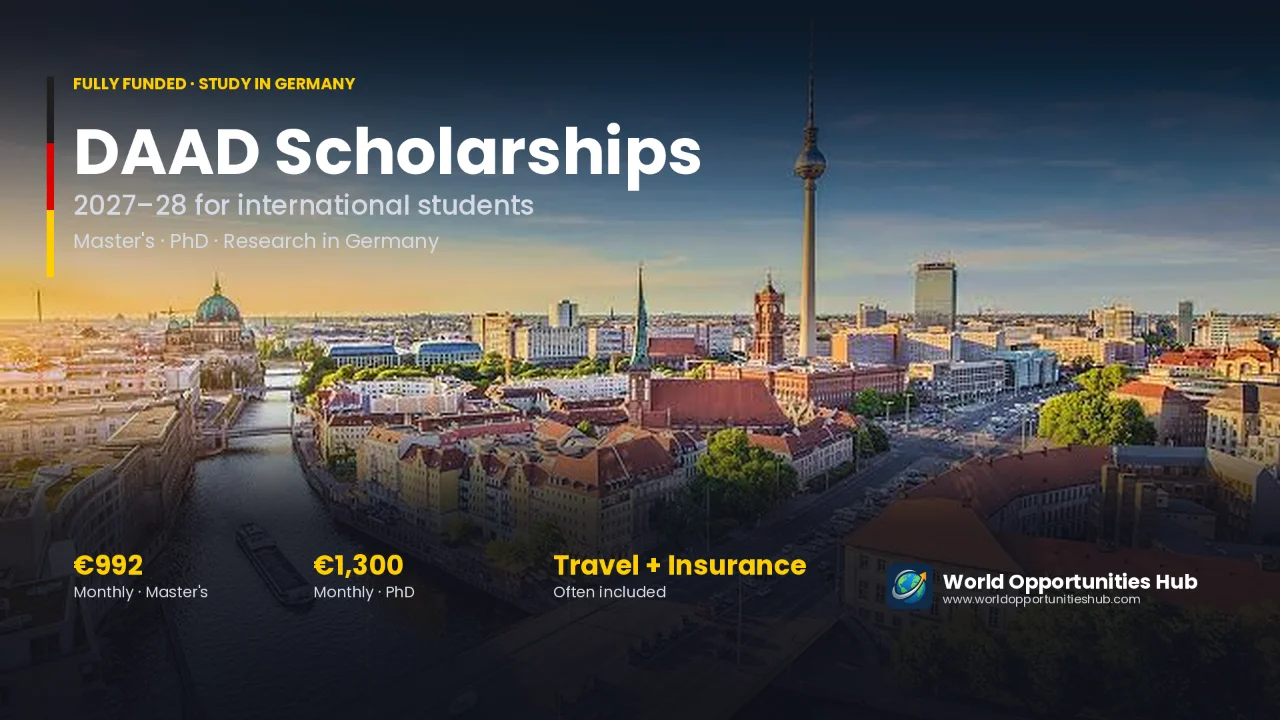
DAAD, the German Academic Exchange Service, is one of the world's largest scholarship organisations. It funds international students and researchers to study, research and learn German in Germany. Scholarships cover master's, PhD and research stays, with a monthly stipend (currently €992 for students and €1,300 for doctoral candidates), a travel allowance and health insurance in many cases. They don't have to be repaid.
Published Nov 6, 2026 · Updated Nov 6, 2026
Last updated: Nov 6, 2026Source: DAAD (German Academic Exchange Service) ↗
Overview
Germany is one of the most popular study destinations in the world. Its public universities charge little or no tuition, its research is world-class, and its degrees are respected everywhere. For international students, the easiest way to get there with full funding is often a DAAD scholarship.
DAAD (Deutscher Akademischer Austauschdienst, or the German Academic Exchange Service) supports well over 100,000 German and international students and researchers every year. It describes itself as the largest funding organisation of its kind in the world. Its scholarships pay a monthly stipend, cover travel and, in many cases, insurance, and never have to be repaid.
But DAAD isn't one scholarship. It's a whole family of programmes, each with its own rules, deadlines and target groups. This guide explains how they work and how to find the right one for you.
Who Are DAAD Scholarships For?
DAAD scholarships mainly support:
- Graduates who want to do a master's degree in Germany
- Doctoral students who want to do a full PhD or a research stay in Germany
- Postdocs and researchers
- Students in some programmes, including internships and German language courses
Many programmes focus on applicants from developing and emerging countries, including Pakistan, India, Bangladesh, Nepal, Nigeria, Kenya, Ghana, Indonesia and many more. Others are open to applicants from almost every country.
Why DAAD Scholarships Stand Out
Most scholarships are offered by one university for one course. DAAD scholarships come from Germany's national agency for international academic exchange, so they open doors across the whole German university system. You get a reliable monthly stipend, support with travel and insurance, and membership in a global network of DAAD alumni. Many of them now hold leading positions in government, universities, business and international organisations.
The Main Types of DAAD Scholarships
1. Development-Related Postgraduate Courses (EPOS)
For professionals from developing and emerging countries who want to do a master's or PhD in a subject linked to development, such as economics, public health, engineering, environmental science, agriculture or governance. This is one of the most popular DAAD programmes for applicants from South Asia and Africa. It usually requires some work experience after your bachelor's.
2. Study Scholarships for STEM Disciplines
For students from developing and emerging countries who want to do a master's in science, technology, engineering or mathematics in Germany.
3. Full Doctoral Programme Grants
For applicants, mainly from developing and emerging countries, who want to complete a full PhD at a German university or research institute.
4. Research Grants for Doctoral Candidates
For PhD students from almost all countries who want to spend a research period in Germany, either for a short stay or as part of a PhD done jointly between their home university and a German one.
5. Master's Scholarships
For graduates who want to complete a full master's degree in Germany. These are mainly offered to people from industrial countries.
6. Hilde Domin Programme
For students and doctoral candidates who are at risk of being denied education or other rights in their home country. You can't apply directly. An institution or organisation in Germany must nominate you, and DAAD then invites suitable candidates to apply.
7. In-Country / In-Region Programmes
Instead of going to Germany, these fund a master's, PhD or postdoc in your own country or another country in your region.
There are also special programmes for musicians and artists, and other programmes for internships and German language courses. The full list is in the DAAD scholarship database.
Understanding the Money
DAAD stipends are paid monthly. The current rates are:
- €992 per month for students (master's level)
- €1,300 per month for doctoral candidates
Depending on the programme, you may also receive:
- A flat-rate travel allowance
- Health, accident and personal liability insurance
- A one-off research allowance
- Family allowances if you bring a spouse or children
- Funding for German language courses
Many German public universities charge no tuition fees or only small semester fees, so your stipend mainly goes toward rent, food, transport and daily life. Living costs vary by city. Munich and Frankfurt are more expensive than cities like Leipzig or Dresden, so factor this in when choosing your university.
The exact benefits differ for each programme and are listed in its call for applications.
How to Find the Right DAAD Scholarship
DAAD has an online scholarship database where you can filter by:
- Your country of origin
- Your current status (graduate, PhD student, postdoc and so on)
- Your subject
The database shows every programme you're eligible for, along with its deadline, requirements and application link. Read the full call for applications carefully before you apply, as each programme's rules are different.
Visa Requirements for Studying in Germany
If you're not from the EU, EEA or Switzerland, you'll usually need a national (D) visa for study or research to take up a DAAD scholarship in Germany. Here's what to know:
- Where to apply: At the German embassy or consulate in your home country, usually by appointment. Some countries have long waiting times, so book as early as possible.
- Documents you'll typically need: a valid passport, your university admission letter, your DAAD scholarship award letter, proof of health insurance, and passport photos. The embassy will tell you the exact list for your country.
- Proof of funds: Most international students must show they can support themselves, often through a blocked account. As a DAAD scholar, your award letter usually serves as proof of funding. Check this with your embassy.
- Health insurance: Required for all students in Germany. Many DAAD programmes include insurance. If yours doesn't, you'll need to arrange it.
- After arrival: Register your address at the local registration office and apply for a residence permit at the foreigners' office (Ausländerbehörde) in your city.
- Working while studying: Students from outside the EU can usually work part-time in Germany within legal limits. Check whether your DAAD programme has its own rules.
- After graduation: Germany allows international graduates to stay and look for work, which makes it a strong choice if you're thinking about a career in Europe.
DAAD and your host university usually help scholarship holders with visa and arrival questions.
How Selection Works
Independent selection committees made up of academics review the applications. They look at:
- Your academic and professional qualifications
- The quality of your study or research plan
- Your potential to make an impact
Special circumstances, such as a disability, may also be considered.
Tips for a Strong Application
- Start early. Many DAAD deadlines fall up to a year before your studies begin.
- Use the scholarship database to find every programme you qualify for.
- Read the full call for applications. Requirements differ a lot between programmes.
- Write a clear motivation letter. Explain why Germany, why that university and course, and how the degree connects to your career and your home country.
- For EPOS, check each course's own requirements and deadline, as many courses set them individually.
- Contact your local DAAD office or Information Centre if you have questions. They're there to help applicants in your country.
Eligibility
Requirements depend on the programme, but generally:
- A completed bachelor's degree (for master's scholarships) or a master's degree (for PhD scholarships)
- Strong academic results
- A clear study or research plan
- For EPOS, usually relevant professional experience after your bachelor's
- Language skills required by your course (English, German or both)
- Some programmes are only open to applicants from certain countries, mainly developing and emerging countries
- For the Hilde Domin Programme, you must be nominated by an institution in Germany
Always check the call for applications for your specific programme.
Benefits / Funding
- A monthly stipend (currently €992 for students and €1,300 for doctoral candidates)
- A flat-rate travel allowance
- Health, accident and personal liability insurance in many programmes
- One-off research allowances (in some programmes)
- Family allowances (in some programmes)
- Funding for German language courses (in some programmes)
- No repayment required
- Membership of the global DAAD alumni network
Required Documents
Most DAAD applications ask for:
- Online DAAD application form (through the DAAD portal)
- CV (often in Europass format)
- Motivation letter
- Academic degree certificates and transcripts
- Recommendation letter(s) from university teachers
- Proof of language skills (English and/or German)
- For EPOS: proof of work experience, plus your course application
- For research grants: a research proposal, a work schedule and a letter of support from your German host supervisor
The exact list differs for each programme.
How to Apply
- Open the DAAD scholarship database from the official page.
- Filter by your country, status and subject to see which programmes you can apply for.
- Read the call for applications for your chosen programme, especially the deadline and documents section.
- Prepare your documents, including your motivation letter, CV, references and language certificates.
- Apply through the DAAD portal using the link in the database.
- Submit before the deadline for your programme.
Important Dates
DAAD doesn't have a single deadline for all its scholarships. Each programme sets its own, and some also depend on your country of origin. Many deadlines fall in the autumn, up to a year before studies start, so if you want to begin in 2027–28, now is the time to check.
FAQs
What is DAAD?
DAAD (Deutscher Akademischer Austauschdienst) is the German Academic Exchange Service. It funds international students and researchers to study and research in Germany.
Are DAAD scholarships fully funded?
Yes. They usually include a monthly stipend, a travel allowance and, in many cases, insurance. Germany's low tuition fees make this enough to cover your studies.
How much is the DAAD stipend?
Currently €992 a month for students and €1,300 a month for doctoral candidates. Some programmes add extra allowances.
Do I have to repay a DAAD scholarship?
No. DAAD scholarships never have to be repaid.
Can students from Pakistan apply?
Yes. Pakistan is among the countries eligible for several major DAAD programmes, including EPOS and full doctoral programme grants. Check the scholarship database for the latest list.
Do I need to speak German?
Not always. Many master's and PhD programmes in Germany are taught in English. Some programmes require German, and some offer German language courses as part of the funding.
What is the deadline?
Each programme has its own deadline. Check the call for applications in the DAAD scholarship database.
What is EPOS?
EPOS (Development-Related Postgraduate Courses) is a DAAD programme for professionals from developing and emerging countries to study development-related master's or PhD courses in Germany.
Do I need a visa?
If you're not from the EU, EEA or Switzerland, yes. You'll usually need a national visa for study or research, applied for at the German embassy in your country.
Can I bring my family?
Some programmes offer family allowances, and family members may join you if visa requirements are met. Check your programme's call for details.
Who do I contact with questions?
Your local DAAD Regional Office or Information Centre, or the DAAD head office in Bonn, Germany.
WorldOpportunitiesHub is an independent information platform. We are not affiliated with or endorsed by DAAD (German Academic Exchange Service). Always verify details on the official website before applying.
Published by Jabeen
Editor, WorldOpportunitiesHub
Jabeen researches, writes and fact-checks every opportunity and guide on WorldOpportunitiesHub, verifying each one against its official source before it's published.