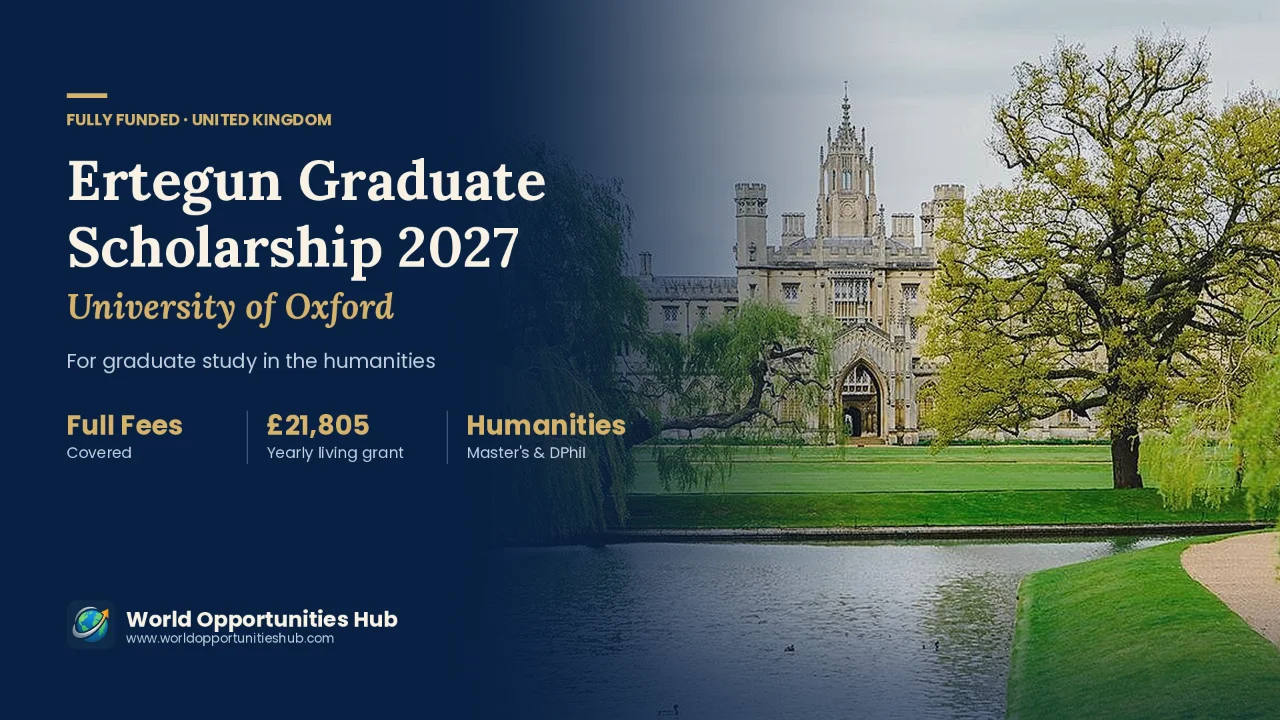
Ertegun Graduate Scholarship 2027 at the University of Oxford, UK (Fully Funded)
The Ertegun Graduate Scholarship is one of the most prestigious humanities awards in the world. It pays full course fees and an annual living grant for graduate study at the University of Oxford. About 15 scholars from any country are chosen each year for master's and doctoral (DPhil) courses in the humanities. They also get exclusive use of Ertegun House, a historic building dedicated to their research and community.
Published Nov 5, 2026 · Updated Nov 5, 2026
Last updated: Nov 5, 2026Source: University of Oxford, Humanities Division ↗
Overview
If you dream of studying history, literature, philosophy, music, languages or classics at Oxford, the Ertegun Graduate Scholarship may be the best award you can apply for. It covers everything, including full tuition and enough money to live on in Oxford. It also comes with something no other scholarship offers: your own beautiful academic home in the heart of the city.
The scholarship was set up by Mica Ertegun in memory of her husband, Ahmet Ertegun, the founder of Atlantic Records. Its mission is to support the brightest humanities students from around the world and build a close community of scholars who share ideas across subjects and cultures.
It's also one of the most competitive awards anywhere. More than 1,500 people apply for about 15 places each year. But you don't need a separate application to be considered. You apply through your normal Oxford course application, with one extra statement.
Who Is This Scholarship For?
This scholarship suits you if you:
- Want to start a full-time master's or DPhil in the humanities at Oxford
- Have an outstanding academic record
- Are passionate about your subject and want to explore it in depth
- Value being part of a close, international and interdisciplinary community
Students from every country can apply, including the UK. There are no nationality restrictions.
Why This Scholarship Stands Out
Many scholarships pay your fees and leave you to it. The Ertegun Scholarship gives you a full community. Scholars have dedicated use of Ertegun House, a quiet, elegant space in Oxford for writing and research. There are also lectures, performances, dinners and events just for scholars. You join a small cohort of brilliant people from around the world, and an alumni network of humanities scholars who stay connected long after Oxford.
Eligible Subjects
The scholarship covers graduate courses run by Oxford's Humanities Division, including:
- Asian and Middle Eastern Studies
- Classics (including classical archaeology)
- English Language and Literature
- Fine Art (DPhil in Contemporary Art History and Theory only)
- History (including History of Art and History of Architecture)
- Linguistics, Philology and Phonetics
- Medieval and Modern Languages (most European languages and literatures)
- Music
- Philosophy
- Theology and Religion
- Interdisciplinary courses: Celtic Studies, Comparative Literature and Critical Translation, Medieval Studies, Film Aesthetics, Women's, Gender and Sexuality Studies, and Digital Scholarship
It also covers some area studies courses:
- MPhil and MSc in Japanese Studies
- MPhil and MSc in Modern Chinese Studies (and the MSc in Contemporary Chinese Studies)
- MPhil and MSc in Modern South Asian Studies
- MSc in Modern Middle Eastern Studies
- MPhil, MSt and DPhil in Classical Archaeology
Always check the official eligible courses list (PDF) on the Ertegun website before applying, since only listed courses qualify.
Understanding the Funding
The scholarship covers your full course fees for the length of your course. You also receive an annual living grant of £21,805 (2026–27 rate), which is normally enough for a single student to live on in Oxford.
If your course lasts more than a year, the award is renewed each year as long as you're making good academic progress. You can't hold the Ertegun Scholarship alongside any other award.
Visa Requirements for International Students
If you're not a UK or Irish citizen (and don't already have UK settled status), you'll need a UK Student visa to study at Oxford. Here's how it works:
- Get your CAS first. After you accept your place, Oxford gives you a Confirmation of Acceptance for Studies (CAS). You need this reference number to apply for your visa.
- When to apply: You can apply up to six months before your course starts, from your home country.
- Visa fee: The Student visa application fee is currently £558.
- Immigration Health Surcharge (IHS): Students pay £776 per year of their visa, upfront. This gives you access to the UK's National Health Service (NHS).
- Proof of funds: You must show you can pay your fees and living costs. Ertegun Scholars can usually use their official scholarship letter as evidence, since it covers fees and living costs. Confirm this with Oxford's Student Immigration team.
- English language: You need to meet Oxford's English requirement for your course. This usually also satisfies the visa requirement.
- Working while studying: Student visa holders can usually work up to 20 hours a week during term, although Oxford limits paid work for full-time graduate students.
- Bringing family: Master's students generally can't bring dependants on a Student visa. DPhil students (research degrees) can.
The scholarship pays for fees and living costs, but visa fees and the IHS aren't mentioned as covered, so budget for them yourself.
Staying in the UK after graduating:
The UK's Graduate Route lets you stay and work after your course without a job offer. For applications from 1 January 2027, master's graduates get 18 months (down from two years), while DPhil graduates still get three years.
Oxford's Student Immigration team helps admitted students with the visa process, so contact them once you've accepted your offer.
What Is the Supporting Statement?
On top of your normal course application, you must submit an Ertegun supporting statement. It's a short form with three questions about why you fit the programme's aims and mission. Without it, your application for the scholarship can't be reviewed.
A good statement:
- Shows why your research matters, not just to your field but to the wider world
- Explains what you'd bring to a small interdisciplinary community of humanities scholars
- Is written in your own voice and is specific about your interests and goals
The Ertegun website offers the 2027 statement template, guidance notes and an applicant webinar. Watch the webinar and read the guidance before you write.
Applying to a Course With an Earlier Deadline
Some courses close before the Ertegun deadline. In that case, you can upload a placeholder statement with your course application, then email the completed statement to Oxford Graduate Admissions before the January deadline. Include your full name, course details and student number.
How Selection Works
- Your faculty reviews your course application and Ertegun statement.
- Shortlisted candidates are interviewed by video or phone, giving you a chance to expand on your statement.
- A committee led by the Head of the Humanities Division, with one representative from each faculty, makes the final decisions with the Board of Ertegun Overseers.
First offers are usually made by the end of March, with more in April. Selection finishes by the end of April. Only successful applicants are contacted, and no feedback is given.
Tips for a Strong Application
- Apply by the January deadline, even if your course has a later one, or you won't be considered.
- Choose an eligible course. Check the PDF list carefully.
- Make your statement personal and specific. Generic answers won't stand out among 1,500 applicants.
- Show interdisciplinary curiosity. The programme values scholars who connect with people outside their own field.
- Prepare for a possible interview by being ready to talk confidently about your research ideas and your statement.
Eligibility
- Open to students of all nationalities, including UK students
- Must be starting a new, full-time graduate course at Oxford
- Must apply for an eligible humanities or area studies course from the official list
- Must meet all course entry requirements, including English language requirements
- Current Oxford students can apply only for a new course, not to fund the remaining years of their current one
- Part-time courses are not eligible
- Can't be held alongside any other scholarship
Benefits / Funding
- Full course fees for the length of your course
- An annual living grant of £21,805 (2026–27 rate)
- Dedicated use of Ertegun House for study and research
- Exclusive lectures, performances, social events and activities for scholars
- A close, international community of humanities scholars
- Membership of the Ertegun alumni network
Required Documents
- Your full Oxford graduate course application, with all the documents your course requires (such as transcripts, references, a research proposal or written work)
- The Ertegun supporting statement, using the official 2027 template, uploaded as a PDF
- In the Funding section of your application, select "Ertegun Graduate Scholarships in the Humanities"
Each Oxford course has its own document requirements, so check your course page carefully.
How to Apply
- Check the eligible courses list on the Ertegun website.
- Download the 2027 supporting statement template and read the guidance notes.
- Watch the applicant webinar (optional, but helpful).
- Complete your Oxford graduate application through the Graduate Application Form.
- In the Funding section, select "Ertegun Graduate Scholarships in the Humanities."
- Upload your supporting statement as a PDF.
- Submit by the early January 2027 deadline for your course.
Important Dates
- September 2026: Oxford applications for 2027 entry open
- Early January 2027: Scholarship deadline (check your course page for the exact date)
- February to March 2027: Shortlisting and interviews
- End of March 2027: First offers made
- April 2027: Further offers, with selection finished by the end of April
- October 2027: Courses begin at Oxford
FAQs
What is the Ertegun Graduate Scholarship?
It's a fully funded scholarship for master's and DPhil students in the humanities at the University of Oxford. It covers fees and living costs, and gives scholars dedicated use of Ertegun House.
Who can apply?
Students of any nationality, including the UK, who are starting a new full-time graduate course in an eligible humanities subject at Oxford.
How much is the scholarship worth?
It covers your full course fees, plus an annual living grant of £21,805 (2026–27 rate).
How many scholarships are awarded?
About 15 each year, from more than 1,500 applicants.
Do I need a separate scholarship application?
No. You apply through your Oxford course application, select the Ertegun Scholarship in the Funding section, and upload the supporting statement.
What is the deadline?
The early January 2027 deadline for your course. If your course has a later deadline, you still need to apply by early January to be considered.
Do I need a visa to study at Oxford?
Yes, if you're not a UK or Irish citizen. You'll need a UK Student visa, which you apply for after receiving your CAS from Oxford.
Does the scholarship cover visa costs?
The official page doesn't mention it. Plan to pay the visa fee (£558) and the Immigration Health Surcharge (£776 per year) yourself.
Can I work in the UK after graduating?
Yes. Through the Graduate Route, master's graduates can stay for 18 months (for applications from 1 January 2027), and DPhil graduates for three years.
Can current Oxford students apply?
Only if they're applying for a new course.
Is there an interview?
Yes. Shortlisted candidates are usually interviewed by video or phone.
Can I study part-time?
No. Only full-time courses are eligible.
Can I hold this scholarship with another award?
No. It can't be combined with any other scholarship.
Will I get feedback if I'm not selected?
No. Only successful applicants are contacted.
Who do I contact with questions?
The Ertegun Administrator at administrator@ertegun.ox.ac.uk.
WorldOpportunitiesHub is an independent information platform. We are not affiliated with or endorsed by University of Oxford, Humanities Division. Always verify details on the official website before applying.
Published by Jabeen
Editor, WorldOpportunitiesHub
Jabeen researches, writes and fact-checks every opportunity and guide on WorldOpportunitiesHub, verifying each one against its official source before it's published.