NOHA Erasmus Mundus Joint Master's in International Humanitarian Action 2027–2029 (Fully Funded Scholarships)
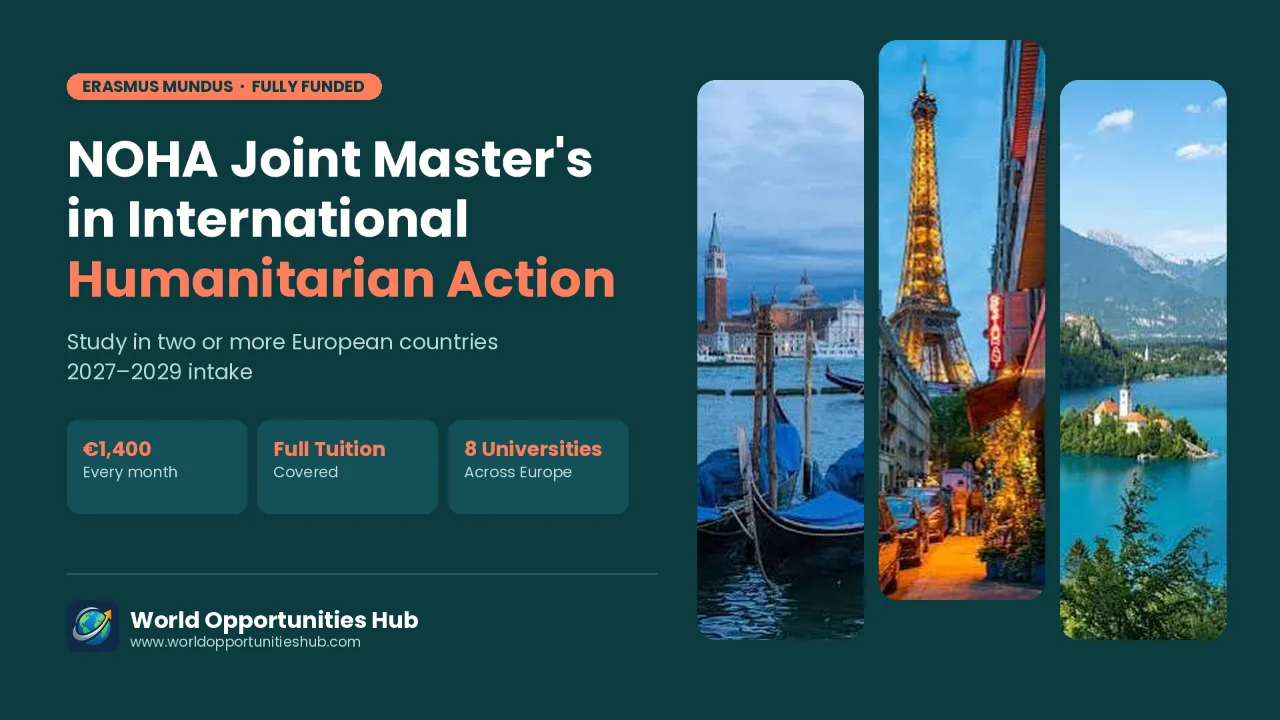
The NOHA Joint Master's in International Humanitarian Action is a two-year Erasmus Mundus programme taught across eight European universities. It prepares students for careers in humanitarian relief, conflict response and international aid. Erasmus Mundus scholarship holders receive €1,400 a month for 24 months, and tuition is included.
Last updated: Nov 2, 2026Source: Network on Humanitarian Action (NOHA), coordinated by the University of Deusto, Spain ↗
Overview
Wars, earthquakes, floods and displacement crises keep growing, and so does the need for people who know how to respond to them well. Good intentions aren't enough in humanitarian work. You need to understand international law, politics, public health, culture, logistics and how aid organisations are run. That's exactly what the NOHA Joint Master's in International Humanitarian Action teaches.
NOHA started in 1993 with support from the European Commission and was the first master's programme dedicated to humanitarian studies. Today it brings together eight European universities and a wide network of partner universities and aid organisations worldwide. More than 3,500 graduates now work in humanitarian relief and international cooperation, both in the field and at headquarters.
For the 2027–2029 intake, the programme is offering 16 Erasmus Mundus scholarships that cover tuition and pay a monthly allowance for the full two years.
What Is Humanitarian Action, and Who Is This Programme For?
Humanitarian action covers the work done to save lives and reduce suffering during and after crises. This includes emergency food and shelter, health care in conflict zones, protecting refugees and displaced people, rebuilding communities and making them more resilient to future disasters.
The NOHA Master's is a good fit if you:
- Already work, volunteer or intern with an NGO, UN agency, Red Cross/Red Crescent society or development organisation and want to move up
- Have a degree in law, social sciences, health, economics, engineering, education or the humanities and want to apply it to crisis response
- Want an internationally recognised degree that opens doors to organisations like UNICEF, UNHCR, the World Food Programme, the Red Cross and major international NGOs
You don't need to be a humanitarian expert already, but some field or volunteer experience will make your application much stronger, especially for the scholarship.
Why This Programme Stands Out
Most master's programmes keep you at one university. With NOHA you study in at least two European countries, and you can then spend a semester at a partner university in places like India, Jordan, Lebanon, Thailand, Indonesia or Colombia, or do a work placement with an aid organisation. You graduate with a joint degree, an international network, and practical experience from different parts of the world, which is exactly what humanitarian employers look for.
How the Two Years Work
The programme is worth 120 ECTS (the European credit system) and runs over four semesters:
- Intensive Programme (early September): A short introductory course that brings the whole class together. The 2026 edition was held at Ruhr University Bochum in Germany.
- Semester 1, Foundation (September – January): At your "home" university. You take common courses in world politics, the legal side of humanitarian action, people and culture, management, and public health.
- Semester 2, Specialisation (February – June): At a different NOHA university of your choice, where you focus on one specialisation.
- Semester 3, Contextualisation (July – January): You choose between regional training at a partner university outside Europe or a work placement with a humanitarian organisation.
- Semester 4, Research (February – June): Back at your home university to write your master's thesis.
In practice, this means you'll live in at least two countries and possibly three. You must study in at least two different countries for at least one semester each. At least one of them must be in the EU, and neither can be the country you live in when you enrol. Online study doesn't count toward this.
The Eight NOHA Universities and Their Specialisations
When you apply, you rank all eight universities in order of preference. Your choice decides where you study and which specialisation you follow in Semester 2.
- Aix-Marseille University (France): Legal and geopolitical approach to humanitarian action. Taught in French.
- University College Dublin (Ireland): Resilience and localising the aid effort.
- University of Malta (Malta): Forced migration and human security.
- University of Groningen (Netherlands): Humanitarian analysis and intervention design.
- Ruhr University Bochum (Germany): Humanitarian policy and practice, from delivering aid to ending needs.
- University of Warsaw (Poland): Armed conflicts and humanitarian action.
- University of Deusto (Spain): Protection in humanitarian action. Semester 1 is in Spanish.
- Uppsala University (Sweden): Conflict, peacebuilding and religion.
How to choose: Think about the kind of work you want to do afterwards. If you're interested in refugees and migration, Malta stands out. For work in conflict zones, look at Warsaw or Uppsala. If you want to design and manage aid projects, Groningen and Bochum are strong options, and Dublin suits those interested in community-led and local responses. Also check the language: most courses are in English, but Aix-Marseille requires French and Deusto requires Spanish for the first semester. Your placement depends on your ranking, but it isn't guaranteed, and it usually can't be changed once decided.
Regional Training Partners (Semester 3)
If you choose regional training, you spend a semester at one of these partner universities:
German Jordanian University (Jordan), Université Saint-Joseph (Lebanon, in French), Doha Institute for Graduate Studies (Qatar), Tata Institute of Social Sciences (India), Chiang Mai University (Thailand), Universitas Gadjah Mada (Indonesia), Deakin University (Australia), Makeni University (Sierra Leone), Pontificia Universidad Javeriana (Colombia), Universidad Rafael Landívar (Guatemala) and Fordham University (USA).
If you prefer hands-on experience, the work placement option combines career development training with a placement at a humanitarian organisation. NOHA's partner organisations include Action Against Hunger, Handicap International, RedR UK, INTERSOS, IMPACT Initiatives, Polish Humanitarian Action and the Belgian Red Cross.
Career Opportunities After NOHA
NOHA graduates work for UN agencies, the Red Cross and Red Crescent movement, international NGOs, government aid agencies, think tanks and universities. Alumni have gone on to roles such as field coordinator at Action Against Hunger, education sector coordinator at UNICEF Lebanon, monitoring and evaluation manager at CARE International UK, and deputy director at the Geneva Centre for Education and Research in Humanitarian Action. Typical career paths include:
- Field coordination and programme management
- Protection and refugee work
- Monitoring, evaluation and research
- Humanitarian policy and advocacy
- Disaster risk reduction and resilience
Eligibility
- A bachelor's degree (at least 180 ECTS or equivalent) in a relevant field such as law, social sciences, medicine, health, food sciences, economics, management, engineering, education or the humanities
- For the scholarship: your degree must already be completed by 15 December 2026. Final-year students can't receive the scholarship.
- Proof of language ability for both your home and host universities
- Some universities (Groningen, Warsaw, Deusto and Uppsala) have extra national entry requirements, so check the "specific national requirements" page for the ones you rank
Language Requirements
English (for most universities):
- IELTS Academic: overall 6.5, with no section below 6.0
- TOEFL iBT: C1 level as specified by NOHA
- Cambridge C1 Advanced (CAE) or C2 Proficiency (CPE)
- Home editions of IELTS and TOEFL are not accepted
You don't need an English test if you're a native speaker from an English-speaking country, or if your bachelor's was taught entirely in English. This must be stated on your diploma or transcript, or confirmed in a letter from your university's registrar.
Other languages:
- French at C1 level for Aix-Marseille University
- Spanish at B2 level for Deusto's first semester (an interview may replace a certificate)
Benefits / Funding
Erasmus Mundus scholarship holders receive:
- Full tuition coverage
- €1,400 a month for 24 months, up to €33,600 in total
- The same amount whatever your nationality or country of residence
- Insurance during the study period (included in the tuition package)
The monthly allowance is meant to cover your travel, visas, settling in, and daily living costs such as rent and food. Living costs vary a lot between cities. €1,400 goes further in Warsaw than in Dublin or Uppsala, so factor that into how you rank your universities.
All students, scholarship or not, get:
- A joint master's degree from a consortium of European universities
- Study in two or more countries
- Regional training abroad or a work placement with a humanitarian organisation
- Access to NOHA's network of over 3,500 alumni working worldwide
What the Scholarship Doesn't Cover
There's no separate allowance for family members, and the scholarship can be reduced if you don't complete the required study periods abroad. You also can't receive it if you've already held an Erasmus Mundus Joint Master's, Master Course or Joint Doctorate scholarship.
Self-Funded Option
If you don't get a scholarship, you can still join as a self-funded student. Tuition is €4,000 per semester (€16,000 for the whole programme), payable in full or in instalments. This covers tuition, library and lab fees, enrolment, exams, your diploma and insurance. Accommodation, food, travel and visa costs are yours to cover. Scholarship applicants who aren't selected can switch to self-funded status.
How Many Scholarships Are Available?
There are 16 Erasmus Mundus scholarships for the 2027–2029 intake:
- 4 for candidates from Erasmus+ Programme Countries (EU member states and associated countries)
- 8 for candidates from Partner Countries (the rest of the world)
- 4 reserved for candidates from specific targeted world regions
No more than 10% of the scholarships can go to people of the same nationality. This keeps the class diverse, and it also means you're competing mainly with applicants from your own region rather than the whole world. You can check which category your country falls under on the Erasmus+ eligible countries page.
Required Documents
All documents are uploaded online through the NOHA application portal. Each file must be 2 MB or smaller.
- Passport copy (main pages)
- Bachelor's diploma (certified copy, with official translation if not in English), plus the Diploma Supplement if you have one
- Academic transcripts (certified copy, with official translation if not in English)
- CV in English (the Europass format is preferred)
- Proof of language ability, if applicable
- Two reference letters in English (French is accepted for Aix-Marseille), signed, dated and written within the last two years. Ideally one is academic and one professional, and neither can come from a family member. Referees can also send letters directly to the NOHA Secretariat.
- Proof of residence, such as a certificate from your municipality, employer or university, or a notarised document, issued within 12 months of the scholarship deadline. Passports, national ID cards and utility bills are not accepted.
- Publications, if you have any
Self-funded applicants who haven't graduated yet should also submit an official confirmation of their expected graduation date, along with transcripts for all courses passed so far.
A note on proof of residence: This document trips up many applicants. It's required because of the mobility rule. You can't study in the country where you live, so NOHA needs to know where that is. Request it early from your local council, union council or employer, and make sure it's dated within the last 12 months.
How to Apply
- Check that your degree, language scores and documents meet the requirements.
- Rank the eight NOHA universities in order of preference, based on specialisation, language and cost of living.
- Ask your two referees for letters well in advance, and give them at least three to four weeks.
- Get your proof of residence, certified copies and any translations ready.
- Apply online at apply.nohanet.org and upload every document, each under 2 MB.
- Submit before 15 December 2026 if you want the scholarship. Incomplete or wrongly formatted applications are ruled out.
How Applicants Are Selected
A Joint Admissions Board, with one representative from each NOHA university, reviews applications. They look at:
- Academic results
- Research experience
- Professional experience in humanitarian action
- Motivation and concern for humanitarian issues
- Multicultural sensitivity
- Language skills
- Reference letters
- Interview results, where interviews are held
- A balance of nationalities and genders in the class
NOHA describes the scholarship as extremely competitive. Successful candidates usually combine strong grades with real humanitarian field experience.
Tips for a Strong Application
- Show your field experience clearly. Volunteering with a relief organisation, working on refugee or disaster response, or community development work all count. In your CV, describe what you did and what changed because of it, not just your job titles.
- Choose referees who know your work well. A detailed letter from a supervisor who has seen you in the field is worth more than a short letter from a famous name.
- Link your specialisation to your goals. If you rank Malta first, explain why forced migration matters to you and what you plan to do with that knowledge.
- Use the Europass CV format. It's the format NOHA prefers, and it makes your profile easy to compare.
- Submit early. Portals slow down near deadlines, and a single missing or oversized file can disqualify you.
Important Dates
- 1 October 2026: Applications opened
- 15 December 2026 (23:59 GMT): Erasmus Mundus scholarship deadline. All documents must be submitted by then.
- January 2027: Ineligible scholarship applicants are notified (appeals within 7 days)
- March 2027: Scholarship results announced (selected, reserve list and not selected)
- 1 April 2027: Deadline for self-funded applicants
- 1 July 2027: Self-funded deadline for applicants without EU citizenship or an EU residence permit
- July 2027: Self-funded admission results
- September 2027: Programme begins
FAQs
What is the NOHA Joint Master's?
It's a two-year Erasmus Mundus master's programme in international humanitarian action, taught across eight European universities with optional study or work placements around the world.
Is the programme fully funded?
For Erasmus Mundus scholarship holders, yes. Tuition is covered and you receive €1,400 a month for 24 months. Self-funded students pay €4,000 per semester.
Who can apply?
Graduates from any country with a relevant bachelor's degree and the required language skills.
Can I apply in my final year of university?
You can apply as a self-funded student. For the scholarship, your degree must be completed by 15 December 2026.
How many scholarships are there?
Sixteen for the 2027–2029 intake: 4 for Programme Country candidates, 8 for Partner Country candidates and 4 for candidates from targeted regions.
Do I need humanitarian work experience?
It isn't strictly required, but it's one of the main selection criteria. Most successful scholarship candidates have field experience.
What language is the programme taught in?
Mostly English. Aix-Marseille teaches in French, and Deusto teaches its first semester in Spanish.
Do I need IELTS or TOEFL?
Yes, unless you're a native English speaker from an English-speaking country or your bachelor's was taught fully in English and this is officially documented. Home editions of the tests aren't accepted.
Can I choose which universities I study at?
You rank all eight in order of preference. NOHA tries to follow your ranking, but placement isn't guaranteed.
Can I study in my own country?
No. Both study countries must be different from your country of residence at the time of enrolment.
What does proof of residence mean?
An official document showing where you live, such as a municipal certificate or a letter from your employer or university, issued within 12 months of the deadline. Passports, ID cards and utility bills aren't accepted.
What if I'm not selected for the scholarship?
You can switch to self-funded status, or look for external funding. NOHA lists around 90 outside scholarship providers on its website.
Can I appeal a decision?
Yes, within 7 days of being notified, using the NOHA Appeal Form sent to nohamasters@deusto.es. You can't add new documents in an appeal.
Who do I contact with questions?
The NOHA Master's Secretariat at the University of Deusto: nohamasters@deusto.es.
Where do I apply?
Online at apply.nohanet.org.
WorldOpportunitiesHub is an independent information platform. We are not affiliated with or endorsed by Network on Humanitarian Action (NOHA), coordinated by the University of Deusto, Spain. Always verify details on the official website before applying.