Amgen Scholars Asia Program 2027 at National University of Singapore (Fully Funded)
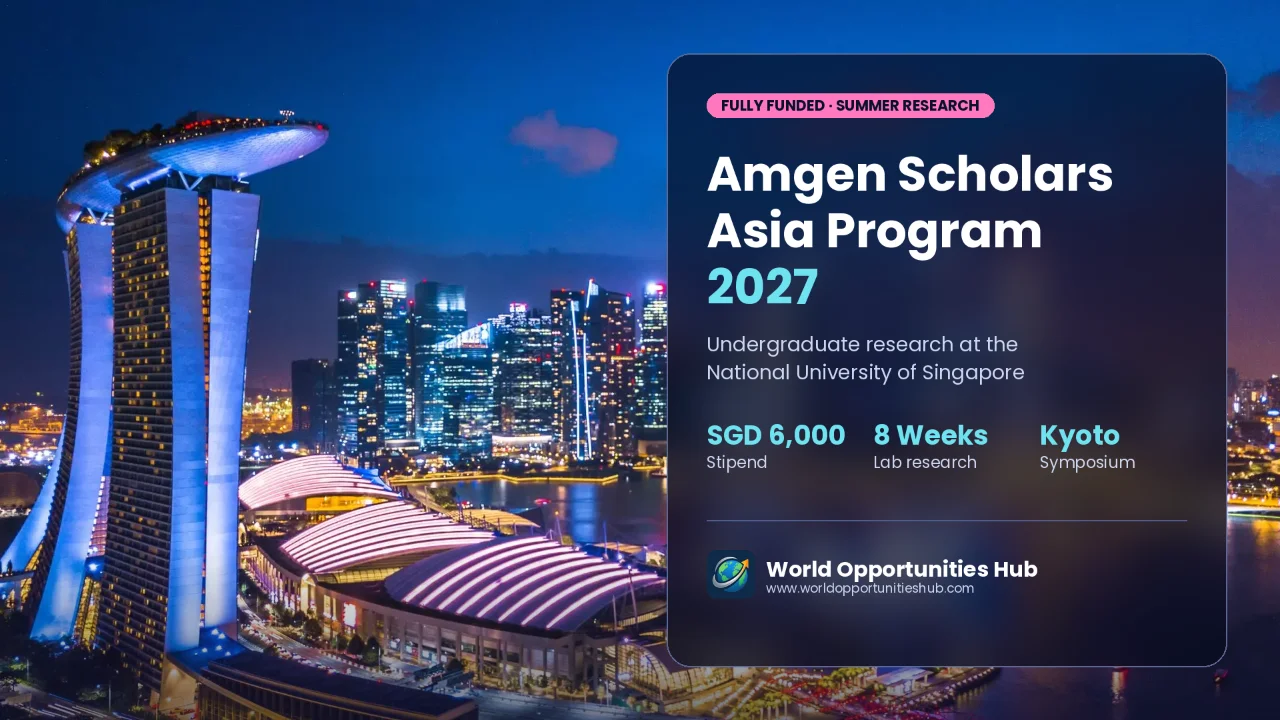
The Amgen Scholars Asia Program gives undergraduate biology and biomedical students from across Asia a fully funded summer of research at the National University of Singapore. Scholars spend about eight weeks in an NUS lab, then present their work at the Amgen Scholars Asia Symposium in Kyoto, Japan. The programme covers accommodation and travel, and pays a SGD 6,000 stipend.
Last updated: Nov 4, 2026Source: National University of Singapore (NUS), Department of Biological Sciences, supported by the Amgen Foundation ↗
Overview
If you're studying biology, biotechnology or biomedical science and you've ever wondered what real research is like, this is one of the best ways to find out. The Amgen Scholars Asia Program brings talented undergraduates from across Asia to the National University of Singapore (NUS), one of the top universities in the world, for a summer of hands-on lab work.
You won't be sitting in classes. For about eight weeks you'll work full time on a real research project in an NUS lab, guided by faculty and lab staff. At the end, you'll travel to Kyoto, Japan, to present your work alongside Amgen Scholars from other Asian host universities.
The Amgen Scholars Program started in the United States in 2006 and later expanded to Europe and Japan. NUS joined in 2018. Thousands of students have taken part worldwide, and many have gone on to PhDs and research careers.
Who Is This Program For?
This program is a great fit if you:
- Are an undergraduate in biology, biotechnology, biomedical sciences or pharmaceutical sciences at a university in Asia
- Have strong grades and enjoy lab work or research
- Are seriously thinking about a PhD
- Want international research experience before applying to graduate school
There's no nationality requirement. What matters is that you're enrolled at a university in an Asian country, including Pakistan, India, Bangladesh, Nepal, Sri Lanka, Indonesia, Malaysia, the Philippines, China and many more.
Why This Program Stands Out
Summer research programs at top universities are usually open only to their own students or to those who can pay their own way. This one is fully funded and open to undergraduates across Asia. You get two months in an NUS lab, a strong recommendation from a research supervisor, a poster and talk you can put on your CV, and a trip to Japan to present your work. For anyone planning to apply for a PhD abroad, this kind of experience can make a real difference.
What a Typical Summer Looks Like
- Week 1: You arrive in Singapore, attend orientation and lab safety training, and meet your host lab.
- Weeks 1–9: You work full time on your research project on weekdays. You'll attend lab meetings, weekly seminars and talks, and information sessions about NUS graduate programs.
- End of research: You present a poster and an oral presentation, and submit a written report.
- Early August: You fly to Kyoto for the three-day Amgen Scholars Asia Symposium, where you present your research and meet scholars from other host universities.
Scholars live in NUS accommodation and can use campus facilities such as the library, health services and sports centre. There are also social activities and excursions during the summer.
Where You Could Be Placed
Host labs come from the NUS Department of Biological Sciences and from several departments at the Yong Loo Lin School of Medicine: Biochemistry, Pharmacology, Anatomy, Physiology, and Microbiology and Immunology. That means projects can range from molecular and cell biology to immunology, neuroscience and drug research.
You don't choose a project when you apply. Project options are shared only with shortlisted applicants, who then rank them. Assignments follow the rankings, but your first choice isn't guaranteed. The program also asks applicants not to contact potential supervisors directly.
Understanding the Money
The SGD 6,000 stipend is meant to cover your daily living costs during the program, such as meals, local transport and social activities, since meals aren't provided separately. It's paid in two parts, around the second or third week and again in the sixth week. You'll need some money of your own for the first couple of weeks until the first payment arrives.
The travel grant works as a reimbursement. You buy your own ticket (after confirming your itinerary with the program team), and NUS pays you back after you arrive. So you'll also need to cover the airfare upfront.
The program doesn't provide health insurance, so you'll need to arrange your own private health and travel insurance before you travel.
A Note for Medical Students
MBBS students can apply, but they need to show a genuine interest in a research career. Students in the third or fourth year of MBBS who are heading into clinical internships are unlikely to be a good fit.
Tips for a Strong Application
- Pick referees who know your work. Your two letters must come from faculty who currently teach you or supervise your research. A supervisor from a research project or lab course is ideal.
- Follow up with your referees. Referees get two weeks to submit their letters, and it's your job to remind them. Missing letters mean your application won't succeed.
- Have your transcript ready in English. If it isn't in English, get an official translation from your university and upload both versions.
- Make your PhD interest clear. The program is designed for future researchers, so show where your interest in research comes from and where you want it to lead.
- Don't leave uploads to the last minute. You'll get a separate three-day window after the online form to upload documents. Use it carefully, because incomplete applications are rejected.
Eligibility
- Be a current undergraduate student (recent graduates are not eligible)
- Be enrolled at a university in Asia that awards a bachelor's degree in biology, biotechnology, biomedical sciences or pharmaceutical sciences
- Have completed at least your first year of university by the program start
- Not graduate before the program ends, and return to your studies for at least one more semester or quarter afterwards
- Have a strong academic record
- Be interested in pursuing a PhD
- Be able to attend the full program, including the symposium in Japan
- Any nationality can apply
Eligible countries (by university location):
- East Asia: China, Hong Kong, Macao, Taiwan, Japan, Mongolia, South Korea, North Korea
- Southeast Asia: Brunei, Cambodia, Indonesia, Laos, Malaysia, Myanmar, Philippines, Singapore, Thailand, Timor-Leste, Vietnam
- Central Asia: Kazakhstan, Kyrgyzstan, Tajikistan, Turkmenistan, Uzbekistan
- South Asia: Afghanistan, Bangladesh, Bhutan, India, Iran, Maldives, Nepal, Pakistan, Sri Lanka
- West Asia: Armenia, Azerbaijan, Bahrain, Cyprus, Georgia, Iraq, Israel, Jordan, Kuwait, Lebanon, Oman, Palestine, Qatar, Saudi Arabia, Syria, Türkiye, United Arab Emirates, Yemen
English proficiency:
You need one of the following, unless your university teaches entirely in English, in which case a letter from your university confirming this is enough:
- TOEFL iBT: 72 or higher
- IELTS: overall 5.5 or higher
- Cambridge English: B2 First (FCE)
- TOEIC: 1095 or higher (or Listening & Reading 785, Speaking & Writing 310)
The Duolingo English Test is not accepted.
Benefits / Funding
International scholars receive:
- Accommodation arranged by NUS
- A travel grant of up to SGD 1,500 for your flight to Singapore and your return flight home from Japan after the symposium
- A stipend of SGD 6,000 for the full program
- A Training Employment Pass (TEP), applied for by NUS, with the fees covered
- Travel to the Amgen Scholars Asia Symposium in Kyoto, Japan
Scholars based in Singapore receive:
- Accommodation for the program
- Round-trip airfare to the symposium in Japan
- A stipend of SGD 6,000
All scholars get:
- About eight weeks of full-time research in an NUS lab
- One-on-one mentorship from faculty and lab staff
- Weekly seminars, lab meetings and graduate school information sessions
- Experience presenting a poster, an oral talk and a written report
- Access to NUS campus facilities and social activities
- Membership in the global Amgen Scholars alumni network
Required Documents
- Online application form
- Academic transcripts. Unofficial transcripts on university letterhead or official electronic PDFs are accepted. Non-English transcripts need an official English translation, and both versions must be uploaded.
- Two reference letters from faculty who currently teach you or supervise your research. Letters must be on university or department letterhead and signed. No special form is needed.
- Proof of English proficiency (test score or a letter from your university)
The official page links to a full "Amgen Application Checklist 2027." Download it before you start so you don't miss anything.
How to Apply
- Check you're eligible: your university, year of study, graduation date and English requirement.
- Download the application checklist from the official page and gather your documents.
- Ask two faculty members for reference letters early, and tell them the deadline.
- Fill in the online application form using the "Apply Here" link on the official page before 1 February 2027, 18:00 Singapore time.
- Upload your documents. After submitting the form, you'll get an email with upload instructions and a three-day window to upload everything.
- Follow up with your referees so their letters arrive within their two-week window.
- Wait for results. Shortlisted applicants are contacted from mid-March 2027. The team asks applicants not to email about application status.
Important Dates
- 1 November 2026: Applications open
- 1 February 2027, 18:00 SGT: Application deadline
- Mid-March 2027 onward: Shortlisted applicants notified
- 30 May 2027: Scholars arrive in Singapore
- 31 May 2027: Orientation and research begin
- 30 July 2027: Research ends
- 2 August 2027: Scholars fly to Japan
- 3–5 August 2027: Amgen Scholars Asia Symposium in Kyoto
- 5 August 2027: Program ends
FAQs
What is the Amgen Scholars Asia Program?
It's a fully funded summer research program at NUS in Singapore for undergraduate biology and biomedical students from universities across Asia. It ends with a research symposium in Kyoto, Japan.
Can students from Pakistan apply?
Yes. Students enrolled at universities in Pakistan, and in any other Asian country listed above, can apply.
Is there a nationality requirement?
No. What matters is that you're studying at a university in Asia.
Is the program fully funded?
Yes. Accommodation is provided, your travel is covered up to SGD 1,500, and you receive a SGD 6,000 stipend. You'll need to arrange your own health and travel insurance.
Are meals provided?
No. The stipend is meant to cover meals, local transport and other daily costs.
When do I get the stipend?
In two payments, around the second or third week and in the sixth week of the program.
Do I pay for my own flight?
You buy the ticket first, after confirming your itinerary with the program team, and NUS reimburses you up to SGD 1,500 after you arrive.
Can recent graduates apply?
No. You must be a current undergraduate who will return to university for at least one more semester after the program.
Can first-year students apply?
Only if you'll have finished your first year by the time the program starts.
I'm an MBBS student. Can I apply?
Yes, if you can show a genuine interest in a research career. Final-year students heading into clinical internships are usually not a good fit.
My degree isn't in biology. Can I still apply?
You can if your transcript shows a solid foundation in biology research. Otherwise, the program says you're unlikely to be selected.
Is IELTS or TOEFL required?
Yes, unless your university teaches fully in English and gives you a letter confirming this. You need IELTS 5.5 or TOEFL iBT 72. Duolingo isn't accepted.
Can I choose my research project?
Shortlisted applicants see the project list and rank their choices. Projects are assigned by ranking, but your first choice isn't guaranteed.
Should I email professors about projects?
No. The program asks applicants not to contact potential supervisors.
Can I take a course or job during the program?
No. The program is full time, and you must attend the lab every weekday.
Who do I contact with questions?
Email amgen_nus@nus.edu.sg (Monday to Friday, 9 am to 5 pm Singapore time). Replies may be slow during the application period.
WorldOpportunitiesHub is an independent information platform. We are not affiliated with or endorsed by National University of Singapore (NUS), Department of Biological Sciences, supported by the Amgen Foundation. Always verify details on the official website before applying.