Erasmus Mundus Master's in Journalism, Media and Globalisation 2027–2029 (Fully Funded Scholarships)
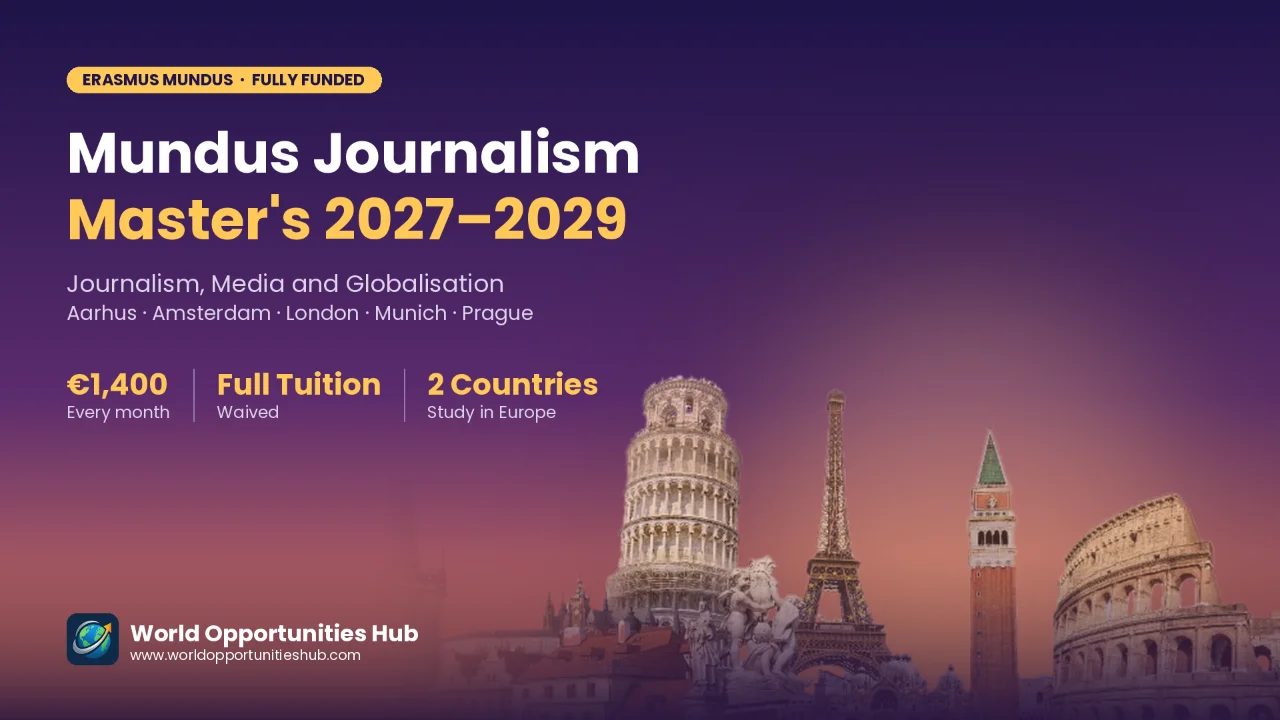
Mundus Journalism is a two-year Erasmus Mundus master's in journalism, media and globalisation. Students spend Year 1 at Aarhus University in Denmark and Year 2 in Amsterdam, London, Munich or Prague. The 10–15 top-ranked applicants receive a full tuition waiver, €1,400 a month for up to 24 months, and free insurance.
Last updated: Nov 4, 2026Source: Mundus Journalism Consortium, coordinated by Aarhus University, Denmark ↗
Overview
Journalism is changing fast. Misinformation spreads across borders, newsrooms are shrinking and rebuilding, and governments everywhere are testing how much freedom the press really has. The journalists who will lead in this world need more than reporting skills. They need to understand how media, power and politics connect across countries.
That's the idea behind Mundus Journalism, an Erasmus Mundus master's that has been running since 2005. You spend two years in two European countries, studying alongside journalists from all over the world, and graduate with a strong academic foundation and a lifelong international network.
For the 2027–2029 intake, the programme is offering 10–15 Erasmus Mundus scholarships that cover tuition and pay a monthly allowance for both years.
Who Is This Programme For?
Mundus Journalism suits you if you:
- Already have some journalism experience and want to think more deeply about the work you do
- Want to understand how media shapes politics, conflict, culture and global events
- Want to move into international reporting, media research, policy or communications roles
- Want to study and build a network in Europe
This is an academic master's, not a hands-on reporting bootcamp. You'll write and report, but the focus is on analysing journalism critically: why news looks the way it does, who it serves, and how it's changing.
Why This Programme Stands Out
Few journalism master's let you live and study in two European countries and graduate with classmates from dozens of nations. Mundus Journalism has been doing this for nearly 20 years, so its alumni network spans newsrooms, universities and international organisations worldwide. And unlike many scholarships, you don't need years of experience. Three months of journalistic work is the minimum.
How the Two Years Work
- Year 1 – Aarhus, Denmark: Every student starts together at Aarhus University. You build a shared foundation in journalism, media and globalisation with the whole class.
- Year 2 – Your specialisation: You move to one of four partner universities to specialise in a topic of your choice.
The programme starts on 1 September 2027 in Aarhus.
The Four Year 2 Specialisations
Your specialisation is chosen in your application form and becomes binding once you submit, so choose carefully.
- Politics & Communication – University of Amsterdam, Netherlands: How news and political communication shape democracy, elections and public opinion.
- Crisis & Conflict – City St George's, University of London, UK: Reporting on war, disasters and humanitarian crises, and the ethics involved.
- Cultures & Contexts – Ludwig-Maximilians-University (LMU), Munich, Germany: How journalism works differently across cultures and media systems.
- Authoritarianism & Transition – Charles University, Prague, Czech Republic: Press freedom, propaganda and media in countries moving toward or away from democracy.
How to Choose Your Specialisation
- Think about your future work. If you want to be a foreign or war correspondent, London's Crisis & Conflict track is the natural fit. If you want to work on election coverage or political reporting, choose Amsterdam. For press freedom and media under pressure, Prague is the strongest match, and Munich suits anyone interested in comparing journalism across countries.
- Check the English rules for that city. Each university sets its own English requirements. Amsterdam is the strictest, while Munich and Prague are the most flexible.
- Think about costs. London and Amsterdam are expensive places to live, and Prague and Munich are generally cheaper. This matters a lot if you're self-funded.
- Remember that your application is judged by the Year 2 university you pick. Make sure your experience and motivation fit that specialisation.
How Competitive Is It?
The programme receives up to 700 applications a year, admits about 80–90 students, and awards 10–15 Erasmus Mundus scholarships to the highest-ranked applicants. That means most students are self-funded, and the scholarship goes to roughly the top 2% of applicants. It's tough, but you apply for admission and the scholarship in the same application, so there's no extra work involved in trying for it.
Who Can't Get the Scholarship?
- Anyone who has already received an Erasmus Mundus scholarship
- Anyone who, by the time the programme starts, will have completed a master's of two years or more after a three-year bachelor's
If you fall into either group, you can still apply as a self-funded student.
Tuition Fees for Self-Funded Students
- Non-EU students: €9,000 for Year 1 and €12,000 for Year 2 (€21,000 in total)
- EU/EEA students: No fee for Year 1 (under Danish law) and €12,000 for Year 2
You don't pay everything at once. Fees are invoiced in instalments before each semester. On top of tuition, self-funded students need to cover rent, food, travel and visas.
What Counts as Journalism Experience?
This is the question applicants ask most, and the programme won't check your experience before you apply. As a rule of thumb, work counts if you researched, reported, wrote, edited or produced content for an audience. That could be at a newspaper, TV or radio station, online outlet, student publication, NGO media team or as a freelancer. Internships and unpaid work count too, as long as the work was journalistic.
If your experience is spread out (for example, part-time freelancing over a year), add up the hours and explain in your application how they equal three months of full-time work.
What Are the Application Reflections?
There's no separate motivation letter. Instead, the Application Form includes short written answers about your journalism experience, academic background, research experience, career goals and motivation. They're judged on critical thinking, motivation and how clearly you write, and the programme asks applicants to write them without AI tools.
Tips for the reflections: Be specific and personal. Instead of "I'm passionate about journalism," describe a story you covered, what you learned, and the question about media it left you wanting to explore. Link that question to your chosen specialisation, and say what you want to do after graduating.
How Applicants Are Selected
The university hosting your chosen specialisation assesses your application, and an Erasmus Mundus Selection Committee of academics reviews all applicants. They look at:
- Academic background: grades, transcripts, academic reference and any awards
- Journalism experience: the relevance, quality and growth of your work, plus your professional reference
- Application Reflections: critical thinking, motivation and clarity
Academic merit gets priority. The 10–15 highest-ranked applicants receive the Erasmus Mundus scholarship, after an extra quality check on the shortlist.
Career Opportunities After Mundus Journalism
Graduates work as reporters and editors at international outlets, foreign correspondents, fact-checkers, media researchers, communications specialists at NGOs and international organisations, and press freedom advocates. Some go on to PhDs in media and communication. The programme also offers career transition support and an active alumni network.
Eligibility
1. A bachelor's degree
- At least three years of full-time study in a relevant subject. Arts, humanities and social sciences count automatically, and other subjects may be accepted.
- Above-average grades, since academic merit is prioritised
- You can apply before graduating, but you must prove completion by 1 August 2027
- If your bachelor's degree is from China, India or Vietnam and you choose Munich, you'll also need an APS Certificate
2. At least three months of journalism experience
- Full-time, or the equivalent in practical experience
- Internships and unpaid work count if they involved real journalistic work
- Must be documented with a contract, payslips, a reference from an editor or another formal confirmation
3. English at C1 level or higher
This applies unless you're a native speaker or qualify for an exemption. Accepted tests are IELTS Academic, TOEFL iBT and Cambridge C1 Advanced or C2 Proficiency. The minimum scores depend on your Year 2 city:
- Amsterdam: IELTS 7.0 with at least 6.5 in each section (onsite only, no One Skill Retake), or TOEFL iBT 100 with Reading 24, Listening 22, Writing 24 and Speaking 25 (no Home Edition). No exemption requests are accepted.
- London: IELTS 7.0 with at least 6.0 in each section (online and One Skill Retake accepted), or TOEFL iBT 100 with 20 in each section (no Home Edition)
- Munich: IELTS 7.0 with at least 6.0 in each section, or TOEFL iBT 100 with 20 in each section (Home Edition and MyBest Scores accepted). Exemptions are granted only in exceptional cases.
- Prague: Same scores as Munich. Applicants whose previous degree was fully in English may request an exemption with official university confirmation.
For all four cities, Cambridge C1 Advanced needs a score of at least 190, or a pass in C2 Proficiency. Applications without valid English documentation are not considered.
4. For the Erasmus Mundus scholarship
- You must not have received an Erasmus Mundus scholarship before
- You must not have completed a master's of two years or more after a three-year bachelor's by the start of the programme
Benefits / Funding
Erasmus Mundus scholarship holders receive:
- A full tuition waiver for both years
- €1,400 a month for up to 24 months (up to €33,600 in total), for housing, food, travel, visas and other living and study costs
- Free health and liability insurance
All students can apply for:
- An Erasmus+ stipend for their second year at their specialisation university. According to the programme, every eligible student has received it so far. It isn't given to students going to the UK, to students returning to their home country, or to students who have had the grant before.
All students get:
- Study in two European countries
- A classmate network from around the world
- Access to the Mundus Journalism alumni community
- Possible eligibility for post-study work visas in Denmark and in your Year 2 country
Required Documents
Everything except your passport goes into one PDF file (maximum 100 MB), in this exact order:
- Application Form: signed, and it must come first. It includes your specialisation choice and the Application Reflections.
- CV: maximum two pages (the Europass format is suggested)
- Academic documents: degree certificate (if you've graduated) and transcripts from all your university studies, with certified English translations if needed
- Journalism documents:
- A signed statement from your employer confirming the type and length of your work (this can be part of your professional reference)
- Exactly three samples of your journalistic work, preferably in English, or with English summaries. Links are fine.
- English proof: a test score report, an approved waiver from your Year 2 university, or nothing extra if your nationality exempts you
- Two reference letters:
- One academic (a professor, head of department, dean or advisor)
- One professional (a current or former employer)
- Both must be on official letterhead, signed and addressed to the "Erasmus Mundus Journalism Consortium"
Your passport copy is uploaded separately (valid, clear, under 10 MB).
Confidential references: If your referee prefers, they can email the letter directly to Bettina Andersen at band@au.dk instead of giving it to you. Unsigned letters are not accepted.
How to name your files:
- Application PDF: First name Surname – City – EU/EEA citizenship or Non-EU citizenship (for example: Sara Khan – Prague – Non-EU citizenship)
- Passport: First name Surname – Nationality – Passport
How to Apply
- Create an Aarhus University ID (AU ID). Wait 30 minutes before using it, or you may get an error.
- Open the Online Registration Form and download the PDF Application Form from it.
- Fill in and sign the Application Form, including your specialisation and reflections.
- Collect your documents and merge them into one PDF in the order listed above.
- Upload your PDF and passport to the Online Registration Form.
- Submit before 10 January 2027, 13:00 CET. You can edit and replace files until the deadline, and only your last version counts.
Tip: You can save a draft by ticking "send me an email with my responses" and clicking "Save response to edit." If you don't, you won't be able to go back and edit. The programme also recommends submitting at least 24 hours early, because upload problems are common close to the deadline.
Important Dates
- 1 November 2026: Applications open
- 10 January 2027, 13:00 CET: Application deadline
- 1 March 2027: Results sent by email
- 15 March 2027: Deadline to accept your offer
- 1 August 2027: Last date to prove you've completed your bachelor's
- 1 September 2027: Programme starts in Aarhus, Denmark
FAQs
What is Mundus Journalism?
It's a two-year Erasmus Mundus master's in journalism, media and globalisation. You study Year 1 in Aarhus, Denmark, and Year 2 in Amsterdam, London, Munich or Prague.
Is it fully funded?
For Erasmus Mundus scholarship holders, yes: full tuition waiver, €1,400 a month for up to 24 months, and free insurance. Most students are self-funded.
How many scholarships are there?
Ten to fifteen for the 2027–2029 intake, given to the highest-ranked applicants.
Do I apply for the scholarship separately?
No. One application covers both admission and the scholarship.
Can international students apply?
Yes. Applicants of all nationalities are welcome.
How much journalism experience do I need?
At least three months of full-time work or the equivalent. Internships and unpaid journalism work count if you can document them.
Can I apply before I graduate?
Yes, but you must prove you've completed your bachelor's by 1 August 2027.
What IELTS score do I need?
An overall score of 7.0, with at least 6.0 in each section for London, Munich and Prague, and 6.5 in each section for Amsterdam.
Can I change my specialisation after applying?
No. Your choice is binding once you submit.
Do I need a motivation letter?
No. The Application Reflections in the form replace it.
How many work samples should I send?
Exactly three, preferably in English or with English summaries. Links are fine.
Can I use AI to write my reflections?
The programme asks applicants not to.
How much is tuition if I'm self-funded?
For non-EU students, €9,000 in Year 1 and €12,000 in Year 2. EU/EEA students pay nothing in Year 1 and €12,000 in Year 2.
When will I get my results?
By 1 March 2027, by email.
Who do I contact with questions?
For the application process and confidential references, Bettina Andersen at Aarhus University (band@au.dk). There's also a contact form on the official website.
WorldOpportunitiesHub is an independent information platform. We are not affiliated with or endorsed by Mundus Journalism Consortium, coordinated by Aarhus University, Denmark. Always verify details on the official website before applying.